

2024 Professional-Cloud-Developer Premium Files Test pdf - Free Dumps Collection
Get ready to pass the Professional-Cloud-Developer Exam right now using our Cloud Developer Exam Package
NEW QUESTION # 94
You are designing a deployment technique for your new applications on Google Cloud. As part of your deployment planning, you want to use live traffic to gather performance metrics for both new and existing applications. You need to test against the full production load prior to launch. What should you do?
- A. Use rolling updates deployment
- B. Use canary deployment
- C. Use A/B testing with traffic mirroring during deployment
- D. Use blue/green deployment
Answer: B
NEW QUESTION # 95
Your company has a data warehouse that keeps your application information in BigQuery. The BigQuery data warehouse keeps 2 PBs of user data. Recently, your company expanded your user base to include EU users and needs to comply with these requirements:
Your company must be able to delete all user account information upon user request.
All EU user data must be stored in a single region specifically for EU users.
Which two actions should you take? (Choose two.)
- A. Create a Cloud Storage bucket in the EU region to store information for EU users only.
- B. Use DML statements in BigQuery to update/delete user records based on their requests.
- C. Use BigQuery federated queries to query data from Cloud Storage.
- D. Re-upload your data using to a Cloud Dataflow pipeline by filtering your user records out.
- E. Create a dataset in the EU region that will keep information about EU users only.
Answer: A,B
Explanation:
Reference:
https://cloud.google.com/solutions/bigquery-data-warehouse
NEW QUESTION # 96
Your code is running on Cloud Functions in project A. It is supposed to write an object in a Cloud Storage bucket owned by project B. However, the write call is failing with the error "403 Forbidden".
What should you do to correct the problem?
- A. Grant the [email protected] service account the roles/ storage.objectCreator role for the Cloud Storage bucket.
- B. Enable the Cloud Storage API in project B.
- C. Grant your user account the roles/iam.serviceAccountUser role for the service-PROJECTA@gcf-admin- robot.iam.gserviceaccount.com service account.
- D. Grant your user account the roles/storage.objectCreator role for the Cloud Storage bucket.
Answer: C
NEW QUESTION # 97
You have recently instrumented a new application with OpenTelemetry, and you want to check the latency of your application requests in Trace. You want to ensure that a specific request is always traced. What should you do?
- A. Wait 10 minutes, then verify that Trace captures those types of requests automatically.
- B. Add the X-Cloud-Trace-Context header to the request with the appropriate parameters.
- C. Write a custom script that sends this type of request repeatedly from your dev project.
- D. Use the Trace API to apply custom attributes to the trace.
Answer: B
Explanation:
Explanation
https://cloud.google.com/trace/docs/setup#force-trace
Cloud Trace doesn't sample every request. To force a specific request to be traced, add an X-Cloud-Trace-Context header to the request.
NEW QUESTION # 98
You are responsible for deploying a new API. That API will have three different URL paths:
* https://yourcompany.com/students
* https://yourcompany.com/teachers
* https://yourcompany.com/classes
You need to configure each API URL path to invoke a different function in your code. What should you do?
- A. Create one Cloud Function exposed directly.
- B. Create three Cloud Functions as three backend services exposed using an HTTPS load balancer.
- C. Create three Cloud Functions exposed directly.
- D. Create one Cloud Function as a backend service exposed using an HTTPS load balancer.
Answer: B
Explanation:
Explanation
https://cloud.google.com/load-balancing/docs/https/setup-global-ext-https-serverless
NEW QUESTION # 99
You are running a web application on Google Kubernetes Engine that you inherited. You want to determine whether the application is using libraries with known vulnerabilities or is vulnerable to XSS attacks. Which service should you use?
- A. Error Reporting
- B. Web Security Scanner
- C. Debugger
- D. Google Cloud Armor
Answer: B
Explanation:
Explanation
https://cloud.google.com/security-command-center/docs/concepts-web-security-scanner-overview Web Security Scanner identifies security vulnerabilities in your App Engine, Google Kubernetes Engine (GKE), and Compute Engine web applications. It crawls your application, following all links within the scope of your starting URLs, and attempts to exercise as many user inputs and event handlers as possible.
NEW QUESTION # 100
You are working on a social media application. You plan to add a feature that allows users to upload images.
These images will be 2 MB - 1 GB in size. You want to minimize their infrastructure operations overhead for this feature.
What should you do?
- A. Create a separate bucket for each user in Cloud Storage. Assign a separate service account to allow write access on each bucket. Transfer service account credentials to the client application based on user information. The application uses this service account to upload images to Cloud Storage.
- B. Change the application to create signed URLs for Cloud Storage. Transfer these signed URLs to the client application to upload images to Cloud Storage.
- C. Set up a web server on GCP to accept user images and create a file store to keep uploaded files. Change the application to retrieve images from the file store.
- D. Change the application to accept images directly and store them in the database that stores other user information.
Answer: B
Explanation:
Explanation/Reference: https://cloud.google.com/blog/products/storage-data-transfer/uploading-images-directly-to-cloud- storage-by-using-signed-url
NEW QUESTION # 101
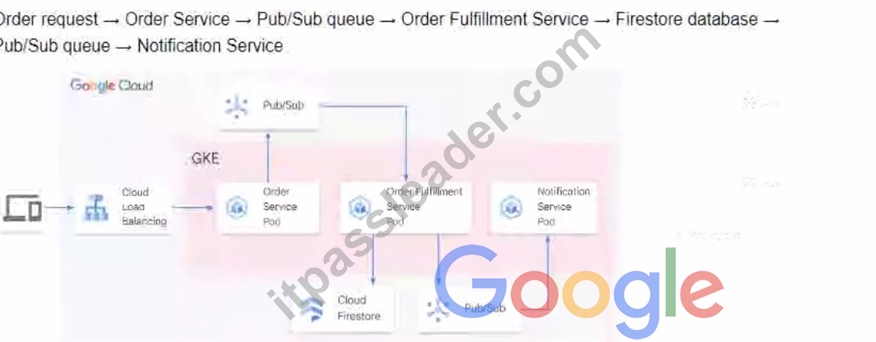
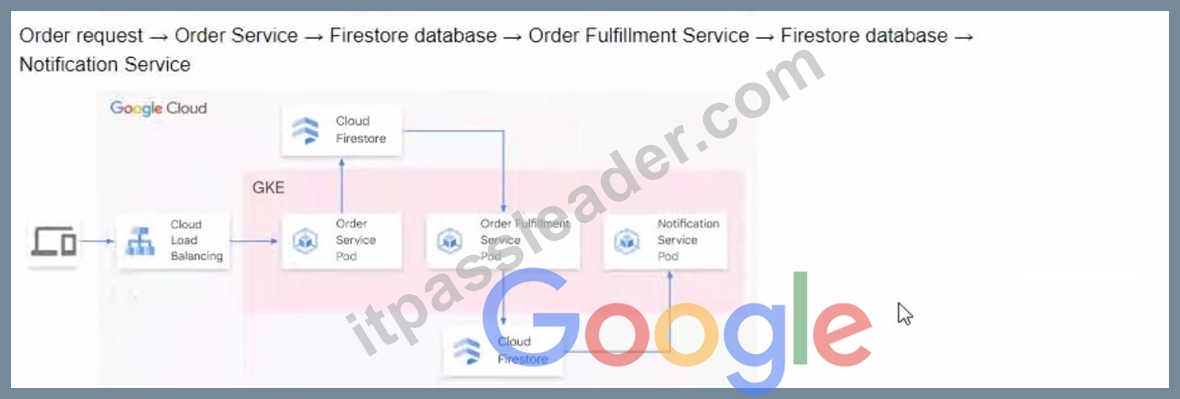
You are developing a flower ordering application Currently you have three microservices.
* Order Service (receives the orders).
* Order Fulfillment Service (processes the orders).
* Notification Service (notifies the customer when the order is filled).
You need to determine how the services will communicate with each other. You want incoming orders to be processed quickly and you need to collect order information for fulfillment. You also want to make sure orders are not lost between your services and are able to communicate asynchronously. How should the requests be processed?
- A.
- B.

- C.

- D.
Answer: B
NEW QUESTION # 102
Your company's development teams want to use Cloud Build in their projects to build and push Docker images to Container Registry. The operations team requires all Docker images to be published to a centralized, securely managed Docker registry that the operations team manages.
What should you do?
- A. Create a separate project for the operations team that has Container Registry configured. Assign appropriate permissions to the Cloud Build service account in each developer team's project to allow access to the operation team's registry.
- B. Create a separate project for the operations team that has the open source Docker Registry deployed on a Compute Engine virtual machine instance. Create a username and password for each development team.
Store the username and password in the source code repository and use it to authenticate against the operations team's Docker registry. - C. Use Container Registry to create a registry in each development team's project. Configure the Cloud Build build to push the Docker image to the project's registry. Grant the operations team access to each development team's registry.
- D. Create a separate project for the operations team that has Container Registry configured. Create a Service Account for each development team and assign the appropriate permissions to allow it access to the operations team's registry. Store the service account key file in the source code repository and use it to authenticate against the operations team's registry.
Answer: C
Explanation:
Explanation/Reference: https://cloud.google.com/container-registry/
NEW QUESTION # 103
You deployed a new application to Google Kubernetes Engine and are experiencing some performance degradation. Your logs are being written to Cloud Logging, and you are using a Prometheus sidecar model for capturing metrics. You need to correlate the metrics and data from the logs to troubleshoot the performance issue and send real-time alerts while minimizing costs. What should you do?
- A. Export the Cloud Logging logs and the Prometheus metrics to Cloud Bigtable. Run a query to join the results, and analyze in Google Data Studio.
- B. Export the Prometheus metrics and use Cloud Monitoring to view them as external metrics. Configure Cloud Monitoring to create log-based metrics from the logs, and correlate them with the Prometheus data.
- C. Create custom metrics from the Cloud Logging logs, and use Prometheus to import the results using the Cloud Monitoring REST API.
- D. Export the Cloud Logging logs and stream the Prometheus metrics to BigQuery. Run a recurring query to join the results, and send notifications using Cloud Tasks.
Answer: B
NEW QUESTION # 104
Your application takes an input from a user and publishes it to the user's contacts. This input is stored in a table in Cloud Spanner. Your application is more sensitive to latency and less sensitive to consistency.
How should you perform reads from Cloud Spanner for this application?
- A. Perform Read-Only transactions.
- B. Perform stale reads using read-write transactions.
- C. Perform stale reads using single-read methods.
- D. Perform strong reads using single-read methods.
Answer: B
Explanation:
Reference:
https://cloud.google.com/solutions/best-practices-cloud-spanner-gaming-database
NEW QUESTION # 105
You need to redesign the ingestion of audit events from your authentication service to allow it to handle a large increase in traffic. Currently, the audit service and the authentication system run in the same Compute Engine virtual machine. You plan to use the following Google Cloud tools in the new architecture:
Multiple Compute Engine machines, each running an instance of the authentication service Multiple Compute Engine machines, each running an instance of the audit service Pub/Sub to send the events from the authentication services.
How should you set up the topics and subscriptions to ensure that the system can handle a large volume of messages and can scale efficiently?
- A. Create one Pub/Sub topic per authentication service. Create one pull subscription per topic to be used by one audit service.
- B. Create one Pub/Sub topic. Create one push subscription with the endpoint pointing to a load balancer in front of the audit services.
- C. Create one Pub/Sub topic. Create one pull subscription per audit service instance to allow the services to share the messages.
- D. Create one Pub/Sub topic per authentication service. Create one push subscription per topic, with the endpoint pointing to one audit service.
- E. Create one Pub/Sub topic. Create one pull subscription to allow the audit services to share the messages.
Answer: E
Explanation:
https://cloud.google.com/pubsub/docs/subscriber "Multiple subscribers can make pull calls to the same "shared" subscription. Each subscriber will receive a subset of the messages."
NEW QUESTION # 106
HipLocal's.net-based auth service fails under intermittent load.
What should they do?
- A. Use a Compute Engine cluster for the service.
- B. Use a dedicated Compute Engine virtual machine instance for the service.
- C. Use App Engine for autoscaling.
- D. Use Cloud Functions for autoscaling.
Answer: B
NEW QUESTION # 107
Your development team has been tasked with maintaining a .NET legacy application. The application incurs occasional changes and was recently updated. Your goal is to ensure that the application provides consistent results while moving through the CI/CD pipeline from environment to environment. You want to minimize the cost of deployment while making sure that external factors and dependencies between hosting environments are not problematic. Containers are not yet approved in your organization. What should you do?
- A. Use Cloud Build to package the application, and deploy to a Google Kubernetes Engine cluster. Use namespaces to separate the environments.
- B. Use Cloud Build to deploy the application as a new Compute Engine image for each build. Use this image in each environment.
- C. Deploy the application using MS Web Deploy, and make sure to always use the latest, patched MS Windows Server base image in Compute Engine.
- D. Rewrite the application using .NET Core, and deploy to Cloud Run. Use revisions to separate the environments.
Answer: B
Explanation:
https://cloud.google.com/architecture/modernization-path-dotnet-applications-google-cloud#phase_1_rehost_in_the_cloud
https://cloud.google.com/architecture/modernization-path-dotnet-applications-google-cloud
NEW QUESTION # 108
You have an application deployed in production. When a new version is deployed, some issues don't arise until the application receives traffic from users in production. You want to reduce both the impact and the number of users affected.
Which deployment strategy should you use?
- A. Blue/green deployment
- B. Rolling deployment
- C. Canary deployment
- D. Recreate deployment
Answer: A
Explanation:
Explanation/Reference: https://thenewstack.io/deployment-strategies/
NEW QUESTION # 109
You are deploying a single website on App Engine that needs to be accessible via the URL http://www.altostrat.com/. What should you do?
- A. Verify domain ownership with Webmaster Central. Define an A record pointing to the single global App Engine IP address.
- B. Define a mapping in dispatch.yaml to point the domain www.altostrat.com to your App Engine service. Create a DNS CNAME record to point to the App Engine canonical name ghs.googlehosted.com.
- C. Verify domain ownership with Webmaster Central. Create a DNS CNAME record to point to the App Engine canonical name ghs.googlehosted.com.
- D. Define a mapping in dispatch.yaml to point the domain www.altostrat.com to your App Engine service. Define an A record pointing to the single global App Engine IP address.
Answer: C
NEW QUESTION # 110
......
Google Professional-Cloud-Developer certification is an excellent way for developers to demonstrate their skills and knowledge in developing and deploying applications on Google Cloud. It is a highly respected certification in the industry, and it can help individuals advance their careers and increase their earning potential.
Master 2024 Latest The Questions Cloud Developer and Pass Professional-Cloud-Developer Real Exam!: https://certlibrary.itpassleader.com/Google/Professional-Cloud-Developer-dumps-pass-exam.html