

Exam Questions and Answers for JN0-649 Study Guide Questions and Answers!
Enterprise Routing and Switching, Professional (JNCIP-ENT) Certification Sample Questions and Practice Exam
NEW QUESTION # 16
You are asked to implement fault tolerant RPs in your multicast network.
Which two solutions would accomplish this behavior? (Choose two.)
- A. Use IGMPv3 with statically defined RPs.
- B. Use MSDP with statically defined RPs.
- C. Use BFD with statically defined RPs.
- D. Use anycast PIM with statically defined RPs.
Answer: B,D
NEW QUESTION # 17
Referring to the exhibit, which two statements are correct? (Choose two.)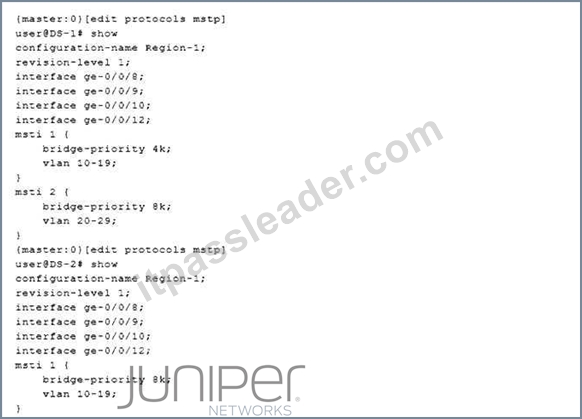
- A. The DS-1 switch will be root bridge for MSTI 2.
- B. The DS-2 switch will be root bridge for MSTI 2.
- C. The DS-1 switch will be root bridge for MSTI 1.
- D. The DS-2 switch will be root bridge for MSTI 1.
Answer: B,D
NEW QUESTION # 18
What is a supplicant in 802.1x authentication?
- A. the device being authenticated
- B. the RADIUS server
- C. the device that prevents the end user device's access until it is authenticated
- D. the authenticating device
Answer: A
NEW QUESTION # 19
Which two authentication methods are available for OSPF on Juniper devices? (Choose two.)
- A. RSA
- B. Certificate
- C. MD5 authentication
- D. none
Answer: C,D
NEW QUESTION # 20
Your company has expanded into office space across the street. The new office space has a single Ethernet connection connected to an unmanaged switch. You must sort traffic based on the IP address into different VLANs once the traffic arrives on your EX Series switches.
Which mechanism would you use to accomplish this task?
- A. Q-in-Q tunneling
- B. dynamic VLANs
- C. MVRP
- D. filter-based VLANs
Answer: D
Explanation:
https://next-hop-self.com/juniper-filter-based-vlan-assignment.html
https://www.juniper.net/documentation/us/en/software/junos/routing-
policy/topics/example/firewall-filter-ex-series-configuring.html
NEW QUESTION # 21
You are asked to establish interface level authentication for users connecting to your network.
You must ensure that only corporate devices, identified by MAC addresses, are allowed to connect and authenticate. Authentication must be handled by a centralized server to increase scalability. Which authentication method would satisfy this requirement?
- A. captive portal
- B. MAC RADIUS
- C. 802.1X with single-secure supplicant mode
- D. 802.1X with multiple supplicant mode
Answer: B
NEW QUESTION # 22
When configuring class of services, what would be you use to allocate bandwidth to a forwarding class?
- A. bandwidth
- B. transmit rate
- C. buffer depth
- D. speed
Answer: B
NEW QUESTION # 23
Which two statements are true regarding BGP load balancing? (Choose two.)
- A. Multipath places a single next-hop in the forwarding table for each destination.
- B. Multipath places multiple next-hops in the forwarding table for each destination.
- C. Multipath provides per-flow load balancing.
- D. Multipath provides per-prefix load balancing.
Answer: B,D
NEW QUESTION # 24
What is the correct authentication processing order on EX Series switches when multiple Layer 2 authentication methods are enabled?
- A. captive portal-> MAC RADIUS -> 802.1x
- B. 802.1x -> MAC RADIUS -> captive portal
- C. 802.1x-> captive portal -> MAC RADIUS
- D. MAC RADIUS -> 1x -> captive portal
Answer: B
NEW QUESTION # 25
What are two similarities between OSPFv2 and OSPFv3? (Choose two.)
- A. 32-bit router ID
- B. support for multiple instances per link
- C. protocol processing per link, not per subnet
- D. virtual links
Answer: A,D
NEW QUESTION # 26
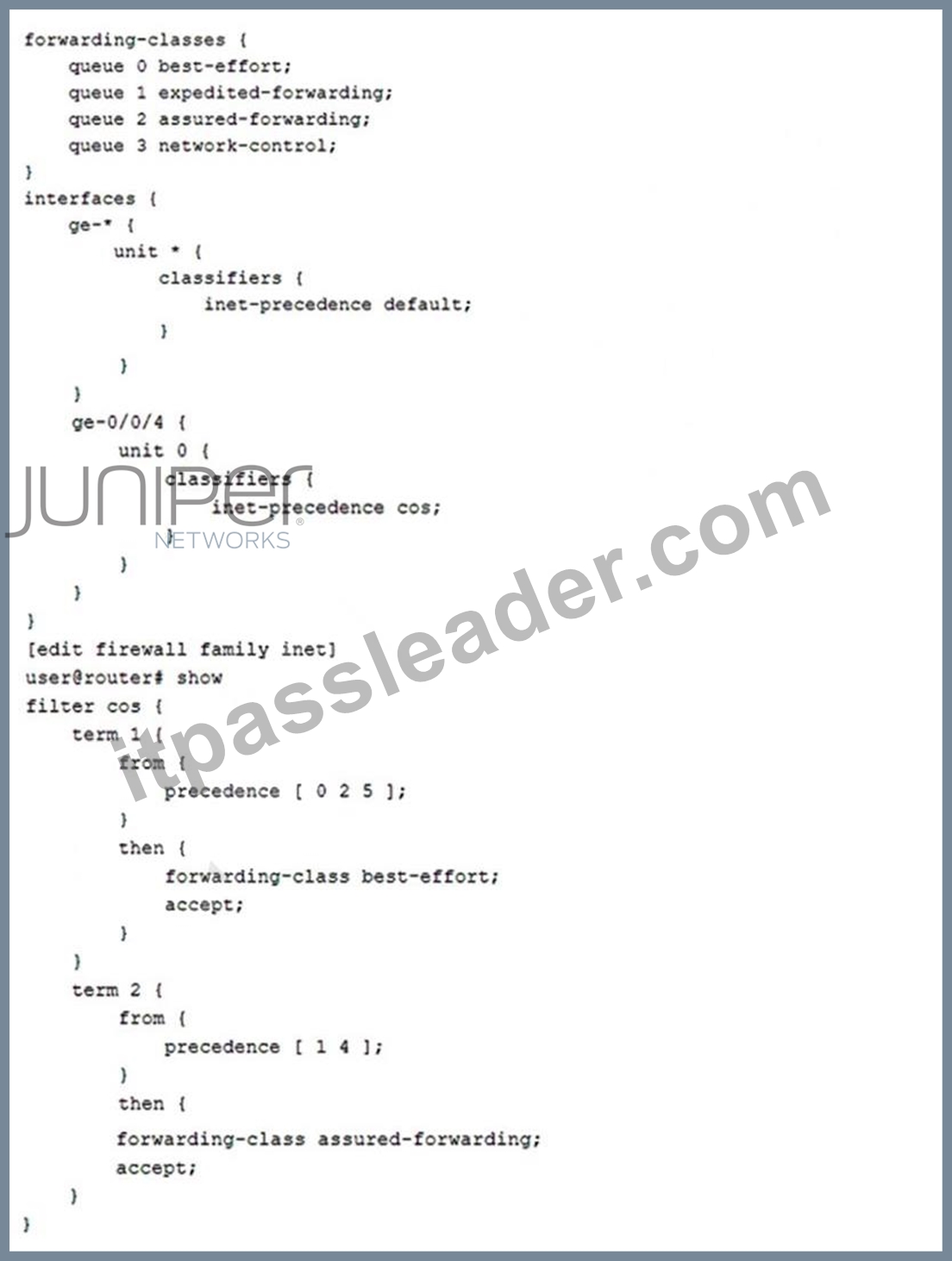
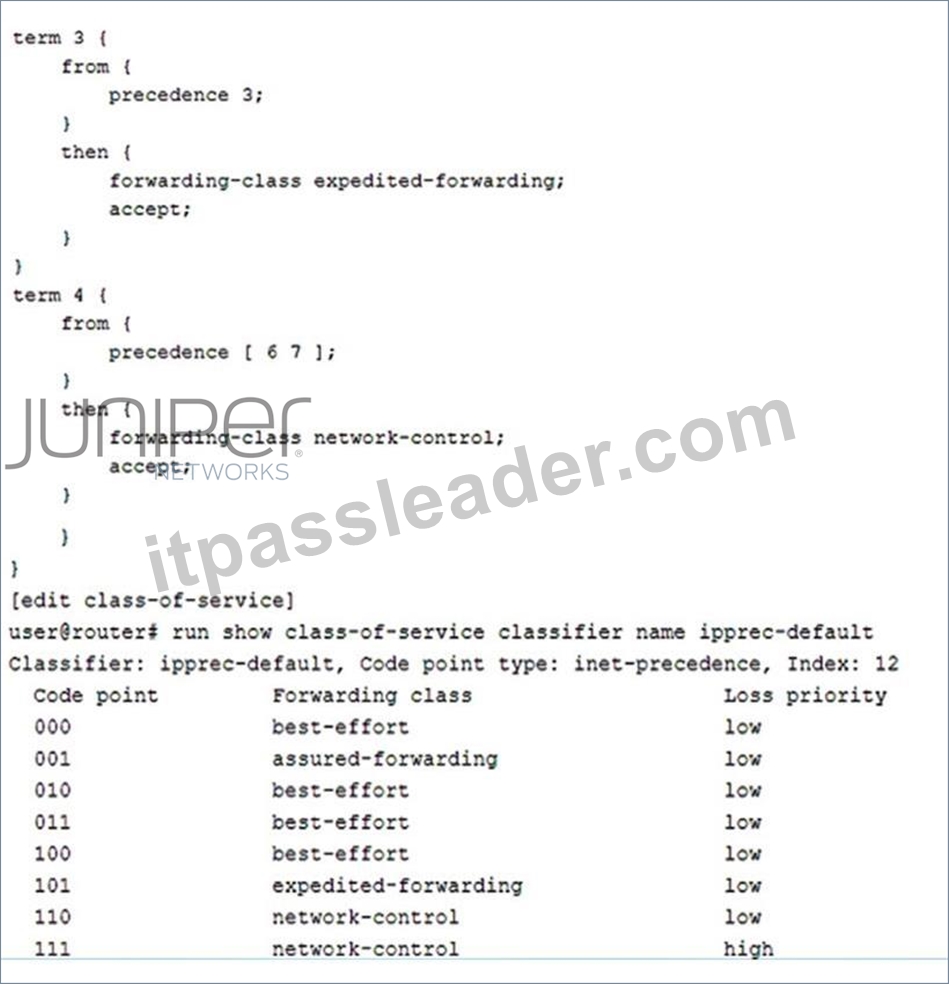
Referring to the exhibit, traffic ingresses on interface ge-0/0/3 and egresses on interface ge-0/0/4.
Which queue does traffic with the IP precedence value of 100 use?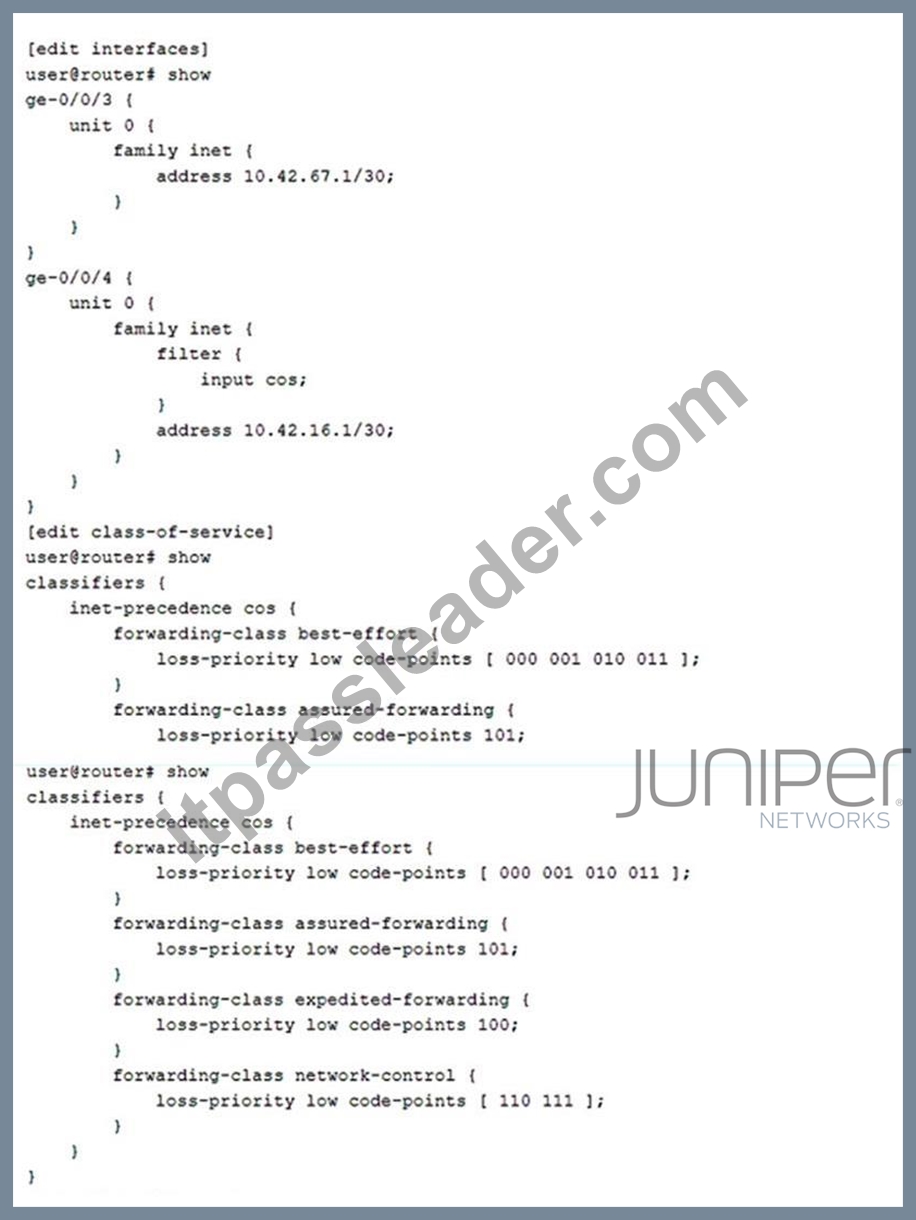
- A. network-control
- B. expedited-forwarding
- C. best-effort
- D. assured-forwarding
Answer: B
NEW QUESTION # 27
You are asked to establish full connectivity between all devices in the BGP network. Referring to the exhibit, which two configuration changes will allow BGP route advertisements? (Choose two.)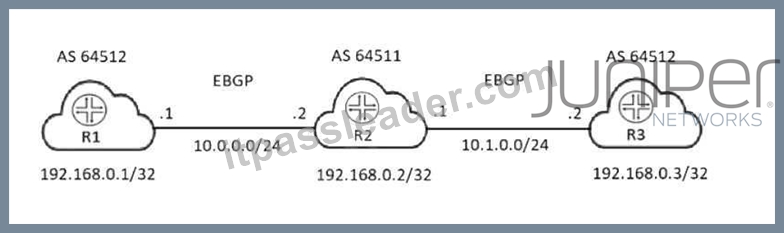
- A. On R1 and R3, include the loops 2 statement at the [edit protocols bgp family inet unicast] hierarchy.
- B. On R1 and R3, include the advertise-peer-as statement at the [edit protocols bgp group external] hierarchy.
- C. On R2, include the loops 2 statement at the [edit protocols bgp family inet unicast] hierarchy.
- D. On R2, include the advertise-peer-as statement at the [edit protocols bgp group external] hierarchy.
Answer: A,D
NEW QUESTION # 28
You want to create an OSPF area that only contains intra-area route information in the form of Type 1 and Type 2 LSAs.
In this scenario, which area is needed to accomplish this task?
- A. totally non-to-stubby area
- B. non-to-stubby area
- C. stub area
- D. totally stubby area
Answer: D
Explanation:
A totally stubby area (TSA) is a stub area in which summary link-state advertisement (type 3 LSAs) are not sent. A default summary LSA, with a prefix of 0.0. 0.0/0 is originated into the stub area by an ABR, so that devices in the area can forward all traffic for which a specific route is not known, via ABR.
NEW QUESTION # 29
Which two statements are true about the 802. 1X output shown in the exhibit? (Choose two.)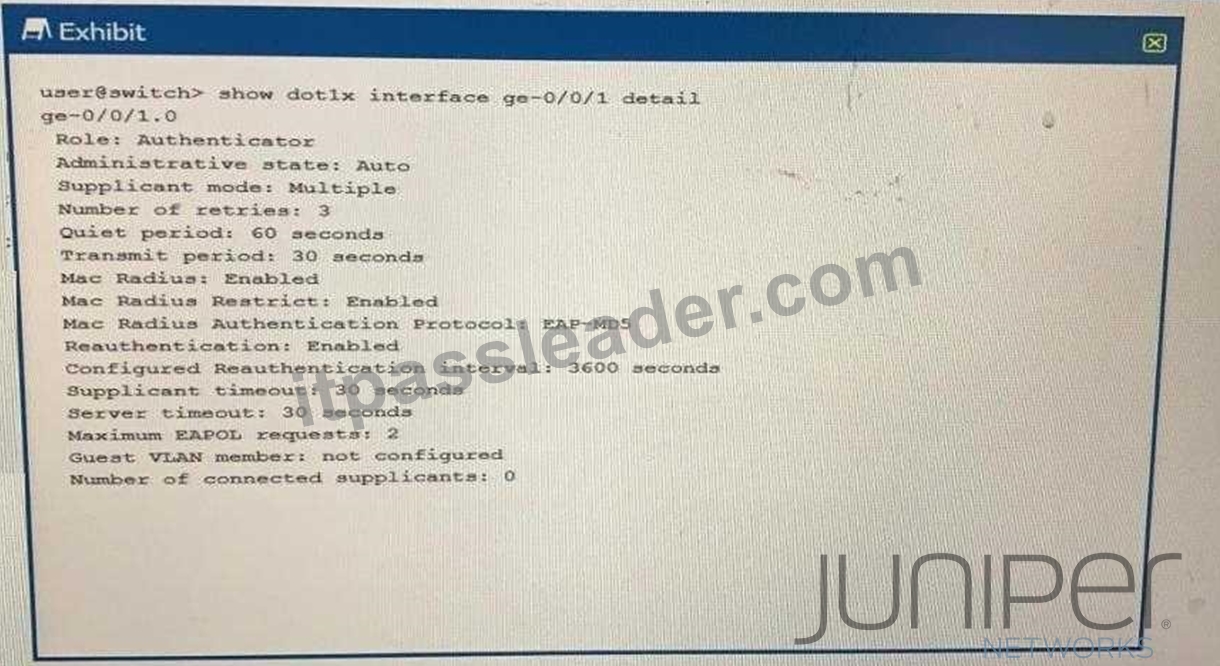
- A. The supplicant is not authenticated using 802. 1X
- B. EAPoL traffic will be sent out of the ge-0/0/1 interface.
- C. EAPoL traffic will not be sent out of the use ge-0/0/1 interface
- D. The supplicant is authenticated using 802. 1X
Answer: A,B
NEW QUESTION # 30
Which three types of ports are used for Junos Fusion Enterprise? (Choose three. )
- A. designated port
- B. cascade port
- C. uplink port
- D. authenticated port
- E. extended port
Answer: B,C,E
NEW QUESTION # 31
There are two BGP routes to 10.200.200.0/24 received from two external peers. Route 1 comes from a neighbor with a router ID of 10.10.100.1 and a peer IP address of 10.10.30.1, and route 2 comes from a neighbor with a router ID of 10.10.200.1 and a peer IP address of 10.10.50.1. Both routes have the same MED value, origin value, AS path length, and local preference number. In this scenario, which statement is correct about the active route?
- A. Route 1 will be active because of the peer IP address.
- B. Route 1 will be active because of the router ID.
- C. Route 2 will be active because of the peer IP address.
- D. Route 2 will be active because of the router ID.
Answer: D
NEW QUESTION # 32
Your enterprise network uses routing instances to support multitenancy. Your Junos devices use BGP to peer to multiple BGP devices. You must ensure that load balancing is achieved within the routing instance.
Which two statements would accomplish this task? (Choose two.)
- A. Configure the multipath option at the [edit routing-instances <instance-name> routing-options] hierarchy.
- B. Configure the multipath option at the [edit protocols bgp group] hierarchy.
- C. Configure a load-balance per-packet policy and apply it at the [edit routing-options forwarding- table] hierarchy.
- D. Configure the multipath option at the [edit protocols bgp group <group-name> neighbor] hierarchy.
Answer: A,B
NEW QUESTION # 33
You will to route Layer 3 PVLAN traffic within the secondary VLAN.
What is required to accomplish this task?
- A. an FBF policy
- B. a community VIAN
- C. an isolated VLAN
- D. an IRB
Answer: D
NEW QUESTION # 34
Referring to the exhibit, there are multiple ASM groups in the 224 0 0.0/4 range Which configuration change is needed to ensure R1 is always the RP for group 224.224.1.1?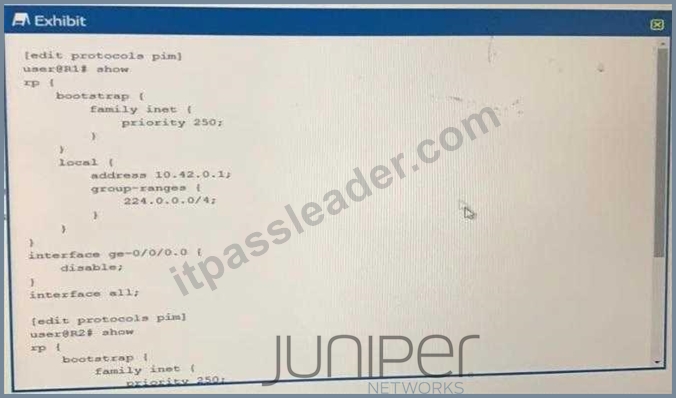
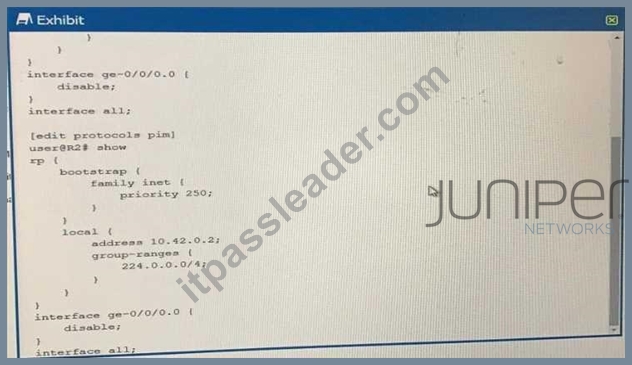
- A. Ensure R1 has a more specific group range
- B. Configure R1 with a higher local RP address
- C. Set the priority on R1 to zero
- D. Increase the priority on R1 to higher than R2
Answer: D
NEW QUESTION # 35
You are configuring, the PVLAN feature on your switches. The PVLAN will span the two EX Series switches shown in the exhibit.
Which three configuration parameters must be enabled on the ports connecting the two switches?
(Choose three. )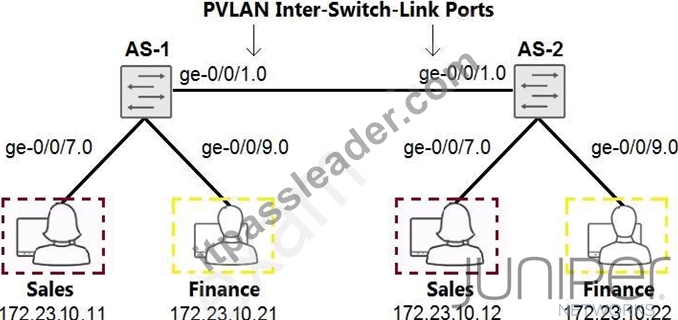
- A. inter-switch-link
- B. family Ethernet-switching
- C. interface-mode access
- D. interface-mode trunk
- E. family inet
Answer: A,B,D
NEW QUESTION # 36
You are running OSPF as your IGP. The interfaces connecting two routers are in the ExStart state. You notice that something is incorrect with the configuration.
Referring to the exhibit, which statement is correct?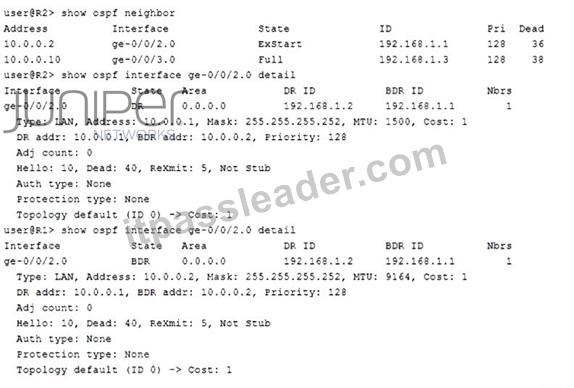
- A. The MTU setting are incorrect.
- B. The IP addresses are incorrect.
- C. The interface type is incorrect.
- D. The subnet mask is incorrect.
Answer: A
NEW QUESTION # 37
Referring to the exhibit, which statement is true?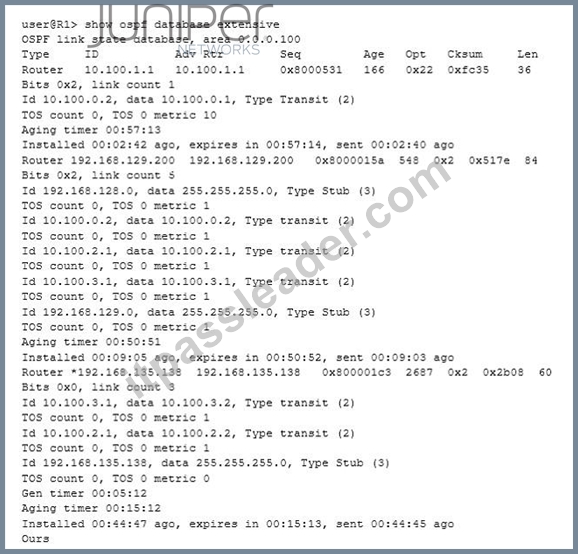
- A. R1 is a backbone router.
- B. R1 has the B bit set.
- C. R1 is an ABR.
- D. R1 is an ASBR.
Answer: D
NEW QUESTION # 38
You are deploying IP phones in your enterprise network that must receive their power through their Ethernet connection. You are using your EX Series switch's PoE ports that support IEEE 802.3af.
In this scenario, what is the maximum amount of power allocated to each interface?
- A. 10.2 W
- B. 30 W
- C. 15.4 W
- D. 50 W
Answer: C
NEW QUESTION # 39
You created a firewall rule to protect the Routing Engine. After applying the rule, your OSPF adjacencies dropped.
How would you solve this problem?
- A. Define a router ID under the [edit routing-options] hierarchy.
- B. Create a firewall term that allows IP protocol 89.
- C. Configure the loopback interface under the [edit protocols ospf] hierarchy.
- D. Apply the firewall filter to the physical ports.
Answer: B
NEW QUESTION # 40
......
JN0-649 certification dumps - JNCIP-ENT JN0-649 guides - 100% valid: https://certlibrary.itpassleader.com/Juniper/JN0-649-dumps-pass-exam.html