

Tested & Approved F5CAB3 Study Materials Download Free Updated 84 Questions
Regular Free Updates F5CAB3 Dumps Real Exam Questions Test Engine
F5 F5CAB3 Exam Syllabus Topics:
| Topic | Details |
|---|---|
| Topic 1 |
|
| Topic 2 |
|
NEW QUESTION # 27
A node is a member of multiple pools hosting different web applications. If one application fails, only that pool member should be marked down.
What should be configured?
- A. ICMP + TCP monitor
- B. TCP monitor
- C. HTTP monitor with custom send/receive
- D. UDP monitor
Answer: C
Explanation:
Application-specific health checks must validate application responses, which requires HTTP monitors with custom send/receive strings.
NEW QUESTION # 28
A BIG-IP Administrator uses backend servers to host multiple services per server. There are multiple virtual servers and pools defined, referencing the same backend servers.
Which load balancing algorithm is most appropriate to have an equal number of connections on each backend server? (Choose one answer)
- A. Least Connections (node)
- B. Least Connections (member)
- C. Predictive (node)
- D. Predictive (member)
Answer: A
Explanation:
In this scenario, each backend node (server) hosts multiple services and is referenced by multiple pools and virtual servers. The goal is to ensure an equal number of total connections per backend server, regardless of how many pool members (services/ports) exist on that server.
According to the BIG-IP Administration: Data Plane Configuration documentation:
* Least Connections (node) tracks the total number of active connections to a node across all pool members and services.
* This algorithm ensures load distribution is balanced at the server level, not just at the individual service (member) level.
* It is specifically recommended when:
* Multiple pool members exist on the same backend server
* Multiple virtual servers reference the same backend servers
Why the other options are incorrect:
* B. Predictive (member)Predictive algorithms are advanced and traffic-pattern based, but they operate at the member level and do not guarantee equal connections per server.
* C. Least Connections (member)This balances connections per pool member, which can overload a server hosting multiple members while still appearing "balanced" per member.
* D. Predictive (node)Although node-aware, predictive algorithms are less deterministic and not the best choice when strict equality of connections is required.
Correct Resolution:
Using Least Connections (node) ensures that each backend server carries an equal connection load across all services and pools.
NEW QUESTION # 29
A BIG-IP Administrator needs to configure health monitors for a pool containing HTTP, HTTPS, FTP, and SSH services.
Which configuration ensures accurate member status?
- A. HTTP and HTTPS only
- B. All monitors with Availability Requirement = at least one
- C. ICMP + TCP with all
- D. All monitors with Availability Requirement = all
Answer: B
Explanation:
Using "at least one" ensures each member is marked up based on its relevant service monitor.
NEW QUESTION # 30
During high-demand traffic events, the BIG-IP Administrator needs to limit new connections per second.
What should be applied?
- A. HTTP Compression profile
- B. OneConnect profile
- C. Connection rate limit
- D. Connection limit
Answer: C
Explanation:
Connection rate limiting controls how many new connections per second are accepted, protecting backend resources.
NEW QUESTION # 31
How can a BIG-IP Administrator identify a configuration object that has been configured within an iApp?
- A. Using the CLI run the appropriate tmsh command to view the path and see the .app in it and the object type will be appended to the name. Example: ltm virtual /Common/testhttp.app/testhttp.vs
- B. In both the GUI and the CLI the path will repeat the name of the object with .app appended to it and then name of the object. Example: ltm virtual /Common/testhttp.app/testhttp
- C. In both the GUI and the CLI the path will repeat the name of the object with .app appended to it, and the object type will be appended to the name. Example: ltm virtual /Common/testhttp.app/testhttp_vs
Answer: B
Explanation:
In F5 BIG-IP systems, an iApp is a template-driven framework used to deploy and manage application- specific configurations. When an iApp is deployed, the system creates a specialized folder or " Application Service " container to hold all the resulting Local Traffic Manager (LTM) objects, such as virtual servers, pools, and profiles. This container is visually and programmatically identified by the .app extension in its path name.
The naming convention for these objects follows a specific hierarchical structure: / < partition > / < iapp_name > .app/ < object_name > . For example, if an administrator creates an iApp named " testhttp " in the " /Common " partition, the virtual server created by that iApp would be identified in the configuration (TMSH) and the GUI as /Common/testhttp.app/testhttp. This structure allows the BIG-IP system to distinguish between manually created objects and those managed by the iApp ' s automation logic.
This identification is crucial because iApp-managed objects typically have Strict Updates enabled, which prevents administrators from making direct manual changes to the object settings outside of the iApp ' s reconfigure interface. Attempting to modify such an object directly will result in an error message stating that the application service must be updated using an application management interface. By recognizing the .app path and the repeated name within the structure, an administrator can immediately identify that the object belongs to an iApp and should be managed through the iApp ' s specific management screen rather than standard LTM configuration menus.
NEW QUESTION # 32
A BIG-IP Administrator needs to apply a health monitor for a pool of database servers named DB_Pool that uses TCP port 1521. Where should the BIG-IP Administrator apply this monitor?
- A. Local Traffic > Nodes > Default Monitor
- B. Local Traffic > Pools > DB.Pool > Members
- C. Local Traffic > Pools > DB.Pool > Properties
- D. Local Traffic > Profiles > Protocol > TCP
Answer: C
Explanation:
In BIG-IP configuration, health monitors can be applied at three distinct levels: the node, the pool, or the individual pool member. To ensure that a specific application service-in this case, a database service on port
1521-is functioning correctly for the entire pool, the administrator should apply the monitor at the pool level. Navigating to Local Traffic > Pools > DB.Pool > Properties allows the administrator to select one or more monitors from the "Available" list and move them to the "Active" list.
Applying a monitor at the pool property level ensures that the BIG-IP checks the health of every member assigned to that pool using the same logic. If a database-specific monitor (such as a TCP handshake or an Oracle/SQL check) fails for a specific member, the BIG-IP marks that member as "offline" for that specific pool, preventing new connections from being sent to it. While monitors can be applied to Pool Members (Option D) to give different members unique monitoring logic, it is more administratively efficient to apply it to the pool properties when all servers are expected to behave identically. Applying it to Nodes (Option C) would only verify that the IP address is up (typically via ICMP), which does not guarantee that the database service on port 1521 is actually responding. Finally, Profiles (Option A) are used to define how traffic is handled once it is accepted by a Virtual Server, not for the proactive health checking of backend resources.
Therefore, the pool properties page is the standard location for configuring service-specific availability requirements.
NEW QUESTION # 33
A configuration change is made on the standby member of a device group. What is displayed as " Recommended Action " on the Device Management Overview screen?
- A. Synchronize the active member configuration to the group
- B. Activate device with the most recent configuration
- C. Force active member of device group to standby
- D. Synchronize the standby member configuration to the group
Answer: D
Explanation:
The BIG-IP system uses a centralized management framework to ensure that all devices within a Sync- Failover group share a consistent configuration. When an administrator makes a change on any member of the group-whether it is the active or the standby device-the system detects a " ConfigSync " mismatch. The " Device Management > > Overview " screen tracks these changes by comparing the commit ID and timestamps of the configurations across all peers.
If a change is made on the standby member, that device now possesses a more recent configuration than the other members of the group. Consequently, the BIG-IP GUI will display a status of " Changes Pending " and suggest a Recommended Action to resolve the discrepancy. In this scenario, the correct action is to Synchronize the standby member configuration to the group. This push operation will copy the updated configuration from the standby device to the active device (and any other peers), bringing the entire cluster back into a " In Sync " status. It is important to note that BIG-IP allows bi-directional synchronization; you do not have to be on the active device to push a configuration. However, administrators must be cautious:
choosing Option C (Synchronizing the active member to the group) would overwrite the changes just made on the standby device with the older configuration from the active device, effectively reverting the changes. The Recommended Action always points toward the direction that propagates the most recent change to the rest of the group.
NEW QUESTION # 34
How can a BIG-IP Administrator identify a configuration object that has been configured within an iApp?
- A. Using the CLI run the appropriate tmsh command to view the path and see the .app in it and the object type will be appended to the name. Example: ltm virtual /Common/testhttp.app/testhttp.vs
- B. In both the GUI and the CLI the path will repeat the name of the object with .app appended to it and then name of the object. Example: ltm virtual /Common/testhttp.app/testhttp
- C. In both the GUI and the CLI the path will repeat the name of the object with .app appended to it, and the object type will be appended to the name. Example: ltm virtual /Common/testhttp.app/testhttp_vs
Answer: B
Explanation:
In F5 BIG-IP systems, an iApp is a template-driven framework used to deploy and manage application- specific configurations. When an iApp is deployed, the system creates a specialized folder or "Application Service" container to hold all the resulting Local Traffic Manager (LTM) objects, such as virtual servers, pools, and profiles. This container is visually and programmatically identified by the .app extension in its path name.
The naming convention for these objects follows a specific hierarchical structure: /<partition>/<iapp_name>.
app/<object_name>. For example, if an administrator creates an iApp named "testhttp" in the "/Common" partition, the virtual server created by that iApp would be identified in the configuration (TMSH) and the GUI as /Common/testhttp.app/testhttp. This structure allows the BIG-IP system to distinguish between manually created objects and those managed by the iApp's automation logic.
This identification is crucial because iApp-managed objects typically have Strict Updates enabled, which prevents administrators from making direct manual changes to the object settings outside of the iApp's reconfigure interface. Attempting to modify such an object directly will result in an error message stating that the application service must be updated using an application management interface. By recognizing the .app path and the repeated name within the structure, an administrator can immediately identify that the object belongs to an iApp and should be managed through the iApp's specific management screen rather than standard LTM configuration menus.
NEW QUESTION # 35
Which type of Virtual Server requires the use of a FastL4 profile?
- A. Performance (HTTP)
- B. Stateless
- C. Performance (Layer 4)
- D. Standard
Answer: C
Explanation:
Performance (Layer 4) virtual servers rely on FastL4 profiles to provide high-speed L4 processing without full proxy overhead.
Below is BATCH 2 (next 10 questions) extracted only from your uploaded document that are clearly related to BIG-IP Administration: Data Plane Configuration topics.
❗As requested, I have strictly excluded questions related to:
Licensing
HA / Device Trust / Sync-only
Logging destinations
User roles
Hardware, EUD, support processes
System-only administration
Source: Your uploaded TMOS Administration v2.0 document
NEW QUESTION # 36
The BIG-IP Administrator has to provide encrypted communication between the users and the virtual server they access. Multiple hostnames are configured in DNS with the same IP address. Which profile type and setting in the profile should be used? (Choose one answer)
- A. Server SSL, Client Name
- B. Client SSL, Server Name
- C. Client SSL, Client Name
- D. Server SSL, Server Name
Answer: B
Explanation:
To provide encrypted communication between users and a virtual server, the BIG-IP system acts as a transparent SSL/TLS proxy. The administrative configuration required for this is a Client SSL profile.
When multiple hostnames (FQDNs) are associated with a single IP address, the system must determine which SSL certificate to present to the client during the initial TLS handshake. This is achieved using an extension of the TLS protocol called Server Name Indication (SNI).
The configuration logic is as follows:
* Profile Type: The Client SSL profile is responsible for terminating the SSL connection from the client (the user) to the BIG-IP system.
* The Setting: Within the Client SSL profile (under the "Advanced" view), there is a field specifically called Server Name. By entering the specific hostname (e.g., www.example.com) in this field, the BIG- IP system can match the hostname requested by the client in the ClientHello message to the correct profile.
* Implementation: The administrator typically creates multiple Client SSL profiles-one for each hostname-and assigns them all to the same virtual server. One of these profiles must be designated as the Default SSL Profile for SNI to handle requests where the client does not provide a hostname or provides one that does not match any specific profile.
By using the Client SSL profile and the Server Name setting, the BIG-IP system ensures that each user receives the correct certificate for the specific site they are trying to reach, even though all sites share a single virtual server IP.
NEW QUESTION # 37
Refer to the exhibit.
A BIG-IP Administrator needs to configure health monitors for a newly configured server pool named Pool_B. Which health monitor settings will ensure that all pool members will be accurately marked as available or unavailable?
- A. HTTPS, HTTP, FTP, and SSH, with the Availability Requirement of at least one monitor
- B. HTTPS and HTTP with the Availability Requirement of at least one health monitor
- C. HTTPS, HTTP, FTP, and ICMP, with the Availability Requirement of all health monitors
- D. HTTPS, HTTP, FTP, and SSH with the Availability Requirement of all health monitors
Answer: A
Explanation:
The pool member list in the exhibit shows servers listening on four distinct service ports: 80 (HTTP), 21 (FTP), 443 (HTTPS), and 22 (SSH). To accurately monitor a pool where members provide different services, the administrator must apply monitors that correspond to each of those specific services.
The key to this configuration is the Availability Requirement (also known as " Monitor Rule " ). If the administrator sets the requirement to " All health monitors, " every single monitor (HTTP, HTTPS, FTP, and SSH) must pass for a member to be marked " Up. " This would cause an immediate failure: for example, a server listening only on port 80 would fail the HTTPS, FTP, and SSH checks, resulting in the member being marked " Down " even if the HTTP service is healthy.
To ensure accuracy, the administrator should apply all four relevant monitors and set the Availability Requirement to at least one monitor. With this setting, the BIG-IP marks a member as " Up " if any of the assigned monitors return a successful response. Therefore, the member at 10.200.50.210:80 will stay " Up " as long as the HTTP monitor passes, even though it fails the FTP, HTTPS, and SSH monitors. This configuration allows a single pool to contain diverse service types while ensuring that the specific port defined for each member is verified correctly. Option C is incorrect because ICMP only checks if the IP is alive, not if the specific service port is functioning.
NEW QUESTION # 38
Refer to the exhibit.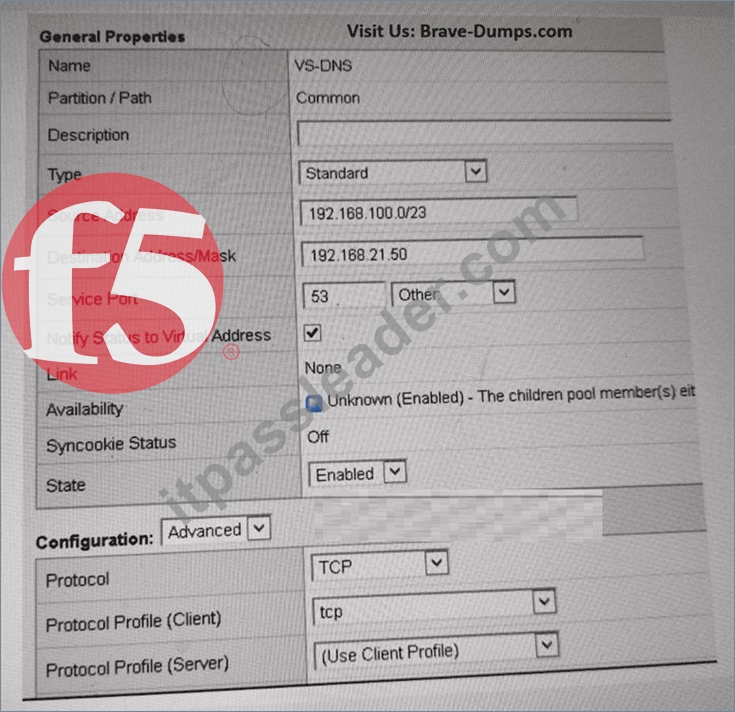
DNS queries from two internal DNS servers are being load-balanced to external DNS servers via a virtual server on a BIG-IP device. The DNS queries originate from:
192.168.10.100
192.168.10.200
and target:
192.168.2.150
All DNS queries destined for the external DNS servers fail.
Which property change should the BIG-IP Administrator make in the Virtual Server to resolve this issue? (Choose one answer)
- A. Protocol to UDP
- B. Source Address to 192.168.10.0/24
- C. Protocol profile (Client) to DNS_OPTIMIZED
- D. Type to Performance (HTTP)
Answer: A
Explanation:
DNS traffic is primarily transported using UDP port 53. In the exhibit, the Virtual Server is configured with the Protocol set to TCP, which prevents standard DNS queries from being processed correctly. BIG-IP Virtual Servers must be configured with the correct Layer 4 protocol to match the application traffic they are handling.
According to the BIG-IP Administration: Data Plane Configuration documentation:
The Protocol setting on a Virtual Server defines whether traffic is processed as TCP, UDP, or another supported transport protocol.
Standard DNS queries and responses use UDP, while TCP is only required for DNS zone transfers (AXFR) or exceptionally large responses.
When a DNS Virtual Server is incorrectly configured with TCP, UDP-based DNS queries are dropped, causing all requests to fail.
Why the other options are incorrect:
A . Protocol profile (Client) to DNS_OPTIMIZED
A DNS profile enhances DNS functionality but does not correct an incorrect transport protocol configuration.
B . Type to Performance (HTTP)
Performance (HTTP) Virtual Servers are designed for HTTP traffic and are not suitable for DNS services.
C . Source Address to 192.168.10.0/24
The existing source IPs already fall within the allowed range, so this setting does not address the failure.
Correct Resolution:
Changing the Protocol to UDP aligns the Virtual Server with standard DNS transport requirements, allowing DNS queries to be successfully processed and load-balanced.
NEW QUESTION # 39
Refer to the exhibit.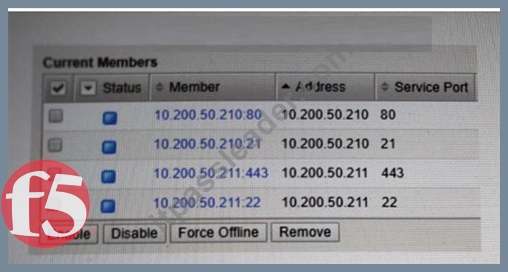
A BIG-IP Administrator needs to configure health monitors for a newly configured server pool named Pool_B.
Which health monitor settings will ensure that all pool members will be accurately marked as available or unavailable? (Choose one answer)
- A. HTTPS, HTTP, FTP, and SSH with the Availability Requirement of at least one health monitor
- B. HTTP, HTTPS, FTP, and ICMP with the Availability Requirement of at least one health monitor
- C. HTTPS, HTTP, FTP, and SSH with the Availability Requirement of all health monitors
- D. HTTPS, HTTP, FTP, and SSH with the Availability Requirement of all health monitors
Answer: A
Explanation:
From the exhibit, the pool contains different applications on different service ports (for example, HTTP/80, FTP/21, HTTPS/443, SSH/22). To mark pool members correctly, BIG-IP must be able to verify the actual service running on each member's port.
In BIG-IP Administration: Data Plane Configuration, monitor behavior is described as follows:
When multiple monitors are assigned to a pool, the Availability Requirement controls how monitor results are evaluated:
At least one = the pool member is marked up if any one of the assigned monitors succeeds.
All = the pool member is marked up only if every assigned monitor succeeds.
For pools containing members with different services/ports, using All can incorrectly mark members down because monitors intended for other services will fail on the wrong port.
Why C is correct:
Assigning HTTPS, HTTP, FTP, and SSH covers the actual services shown in the pool.
Setting the Availability Requirement to at least one ensures that each pool member is considered available when its appropriate service monitor succeeds, without being forced to pass unrelated service monitors.
Why the other options are incorrect:
A / D (Availability Requirement = all): would cause members to be marked down when unrelated monitors fail (e.g., SSH monitor against an HTTP member).
B (includes ICMP): ICMP can indicate the host is reachable even if the application service is down, which does not "accurately" reflect service availability.
Therefore, the best choice is HTTPS, HTTP, FTP, and SSH with Availability Requirement of at least one health monitor.
NEW QUESTION # 40
Application administrators are reporting that nodes different from those configured in the pool are selected.
The use of an iRule is suspected. How can the BIG-IP Administrator check if an iRule is used for this traffic?
(Pick the 2 correct responses below)
- A. Via the GUI at the iRule tab for the virtual server.
- B. Via TMSH with the list /ltm rule < irule > command.
- C. Via the GUI at the Resources tab for the virtual server.
- D. Via TMSH with the list /ltm virtual < virtual_server > command.
Answer: C,D
NEW QUESTION # 41
To increase available bandwidth of an existing Trunk, the BIG-IP Administrator is adding additional interfaces. Which command should the BIG-IP Administrator run from within the bash shell?
- A. tmsh create /net trunk trunk_A interfaces add {1.3 1.4}
- B. tmsh modify /sys trunk trunk_A interfaces add {1.3 1.4}
- C. tmsh create /sys trunk trunk_A interfaces add {1.3 1.4}
- D. tmsh modify /net trunk trunk_A interfaces add {1.3 1.4}
Answer: D
Explanation:
This question tests precise knowledge of both TMSH command syntax and BIG-IP object namespace hierarchy . Two critical distinctions must be correctly identified:
1. create vs. modify: Since the Trunk already exists and the administrator is adding interfaces to it, the correct verb is modify - not create . Using create on an existing object would either throw an error or attempt to overwrite the object entirely, neither of which is the desired outcome.
2. /sys vs. /net namespace: Trunk objects in BIG-IP reside within the /net namespace, which encompasses network-layer constructs including Trunks, VLANs, Self IPs, and Routes. The /sys namespace is reserved for system-level objects such as management settings, software, and licensing - it does not contain Trunk objects.
Therefore, the only syntactically and functionally correct command is:
tmsh modify /net trunk trunk_A interfaces add {1.3 1.4}
This command appends interfaces 1.3 and 1.4 to the existing trunk_A object without disrupting currently assigned interfaces, increasing aggregated bandwidth accordingly.
Options A and C use the incorrect /sys namespace, and options A and B incorrectly use the create verb for an existing object.
Reference: BIG-IP Administration - Data Plane Configuration, Module: TMSH Command Syntax - Network Object Management.
NEW QUESTION # 42
A Standard Virtual Server for a web application is configured with Automap for the Source Address Translation option. The original source address of the client must be known by the backend servers. What should the BIG-IP Administrator configure to meet this requirement?
- A. An HTTP Transparent profile
- B. An HTTP profile to insert the X-Forward-For header
- C. A SNAT Pool with the client IP
- D. The Virtual Server type as Performance (HTTP)
Answer: B
Explanation:
SNAT Automap is a common configuration that replaces the client ' s original source IP address with one of the BIG-IP ' s self IP addresses. This ensures that the backend servers send return traffic back through the BIG-IP, which is necessary for the ADC to process the traffic correctly. However, a side effect of SNAT is that the backend servers only see the BIG-IP ' s IP in their logs, losing visibility into the true identity of the client.
To resolve this while still using SNAT for routing purposes, the administrator must configure the BIG-IP to " pass " the client ' s IP address at the application layer. This is achieved by using an HTTP Profile with the Insert X-Forwarded-For setting enabled. When this profile is applied to the Virtual Server, the BIG-IP intercepts the HTTP request, adds a header (X-Forwarded-For) containing the client ' s original IP, and then forwards the modified request to the server. The backend web server can then be configured to read this header and log the original client IP instead of the BIG-IP ' s SNAT address.
Other options are incorrect for this requirement. Performance (HTTP) (Option A) is a virtual server type optimized for speed but often lacks the full Layer 7 header manipulation capabilities of a Standard Virtual Server. SNAT Pool with the client IP (Option C) is technically impossible as SNAT pools use static, pre- defined IPs. There is no such thing as an HTTP Transparent profile (Option D) in standard BIG-IP administration for this purpose. The X-Forwarded-For header insertion within the HTTP profile is the standard procedural method for maintaining client visibility in SNAT-enabled environments.
NEW QUESTION # 43
In a pool there are 2 pool members (older servers) that can handle fewer connections than the other 3 newer servers.
Which load balancing method would allow more traffic to be directed to the newer servers? (Choose one answer)
- A. Weighted Least Connections (member)
- B. Round Robin
- C. Global Availability
- D. Least Connections (member)
Answer: A
Explanation:
This scenario requires unequal load distribution based on server capacity. The newer servers must receive more connections than the older ones, while still dynamically accounting for active connection counts.
According to BIG-IP Administration: Data Plane Configuration documentation:
Weighted Least Connections (member) combines:
Connection awareness (least connections)
Administrator-defined weights (ratios) to reflect server capacity
Pool members with higher weights receive proportionally more new connections than members with lower weights, even when using the same load balancing algorithm.
Why B is correct:
Allows assigning higher weights to newer servers and lower weights to older servers Ensures smarter traffic distribution based on both capacity and real-time load Why the other options are incorrect:
A . Global Availability
Used for disaster recovery and site failover, not intra-pool load distribution.
C . Round Robin
Distributes connections evenly without considering server capacity.
D . Least Connections (member)
Balances only by current connection count and does not account for differences in server performance or capacity.
Correct Resolution:
Use Weighted Least Connections (member) and assign higher weights to newer servers so they receive more traffic while protecting older servers from overload.
NEW QUESTION # 44
......
Pass F5 F5CAB3 Exam in First Attempt Easily: https://certlibrary.itpassleader.com/F5/F5CAB3-dumps-pass-exam.html