

Passing Oracle 1Z1-082 Exam Using 2026 Practice Tests
1Z1-082 Study Guide Brilliant 1Z1-082 Exam Dumps PDF
Oracle 1Z0-082 exam, also known as the Oracle Database Administration I exam, is designed for individuals who are interested in pursuing a career as an Oracle database administrator. 1Z1-082 exam assesses the candidate's knowledge and skills in various areas of database administration, including database architecture, installation and configuration, backup and recovery, security management, and database performance tuning. 1Z1-082 exam is intended to test the candidate's ability to perform tasks related to Oracle database administration in a real-world environment.
NEW QUESTION # 69
In one of your databases, user KING is:
1. Not a DBA user
2. An operating system (OS) user
Examine this command and its output:
What must you do so that KING is authenticated by the OS when connecting to the database instance?
- A. Unset REMOTE_LOGIN_PASSWORDFILE
- B. Grant DBA to KING
- C. Have the OS administrator add KING to the OSDBA group
- D. Alter user KING to be IDENTIFIED EXTERNALLY
- E. Set OS_AUTHENT_PREFIX to OPS$
Answer: A
NEW QUESTION # 70
Which three statements are true about single-row functions? (Choose three.)
- A. They return a single result row per table
- B. They can accept only one argument
- C. The data type returned can be different from the data type of the argument
- D. They can be used only in the WHERE clause of a SELECT statement
- E. They can be nested to any level
- F. The argument can be a column name, variable, literal or an expression
Answer: C,E,F
NEW QUESTION # 71
Which two statements are true about the Oracle Data Dictionary?
- A. It is owned by the system user.
- B. It is owned by the sys user.
- C. All data dictionary view joins base tables to dynamic performance views.
- D. Data dictionary views are always created with queries that join two or more base tables.
- E. Data dictionary base tables can be queried directly.
Answer: B,E
NEW QUESTION # 72
Examine the description of the CUSTOMERS table: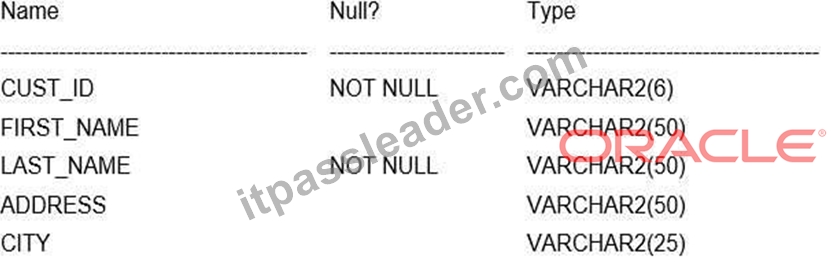
You want to display details of all customers who reside in cities starting with the letter D followed by at least two characters.
Which query can be used?
- A. SELECT * FROM customers WHERE city LIKE 'D_';
- B. SELECT * FROM customers WHERE city = '%D_';
- C. SELECT * FROM customers WHERE city = 'D_%';
- D. SELECT * FROM customers WHERE city LIKE 'D_%';
Answer: D
NEW QUESTION # 73
Which three statements are true about Oracle synonyms? (Choose three.)
- A. A synonym can be available to all users
- B. A synonym cannot be created for a PL/SQL package
- C. A synonym created by one user can refer to an object belonging to another user
- D. A SEQUENCE can have a synonym
- E. Any user can drop a PUBLIC synonym
Answer: A,C,D
NEW QUESTION # 74
The customers table has a cust_last_name column of data type varchar2. The table has two rows whose "jst_last_name values are Andersen and Ausson. Which query produces output for cust_last_xame containing Oder for the first row and Aus for the second?
- A. SELECT REPLACE<TRIM<TRAILING 'son* FROM cust_last_name), 'An', *O'> FROM customers;
- B. SELECT INITCAP (REPLACE(TRIM('son' FROM cust_last_name), 'An', 'O*)) FROM customers;
- C. SELECT REPLACE(SUBSTR(cust_last_name, -3), 'An', 'O') FROM customers;
- D. SELECT REPLACE(REPLACE(cust_last_name, 'son', ''), 'An', 'O'> FROM customers;
Answer: A
NEW QUESTION # 75
Examine these SQL statements which execute successfully: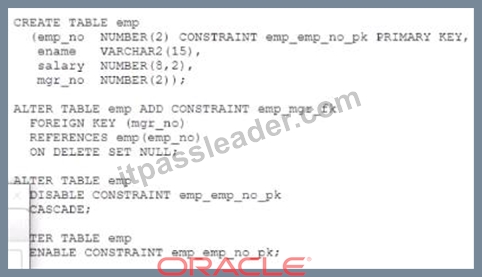
Which two statements are true after execution?
- A. The primary key constraint will be enabled and deferred.
- B. The primary key constraint will be enabled and immediate.
- C. The foreign key constraint will be disabled.
- D. The foreign key constraint will be enabled and deferred.
- E. The foreign key constraint will be enabled and immediate.
Answer: C
NEW QUESTION # 76
Which three statements are true about the naming methods and their features supported by Oracle database used to resolve connection information?
- A. Directory Naming requires setting the TNS_ADMIN environment variable on the client side.
- B. Directory Naming can be used if Connect-Time Failover is required.
- C. Local Naming requires setting the TNS_ADMIN environment variable on the client side.
- D. Local naming can be used if Connect-Time Failover Is required.
- E. A client can connect to an Oracle database instance even If no client side network admin has been configured.
- F. Easy Connect supports TCP/IP and SSL.
Answer: A,D,E
NEW QUESTION # 77
Examine the description of the PRODUCT_STATUS table:
The status column contains the values 'in stock' or 'out of stock' for each row.
Which two queries will execute successfully?
- A. SELECT prod_id q's not available" FROM product_status WHERE status = 'OUT OF STOCK*;
- B. SELECT prod_id I I q' ('s not available) ?'CURRENT AVAILABILITY' FROM product_status WHERE status = 'OUT OF STOCK
- C. SELECT prod_id "CURRENT AVAILABILITY" II q'<'s not available)' FROM product_status WHERE status = 'OUT OF STOCK
- D. SELECT prod_id II q'l's not available)' FROM product_status WHERE status = 'OUT OF STOCK';
- E. SELECT prod_id I I q' (*s not available)' "CURRENT AVAILABILITY" FROM product_status WHERE status = 'OUT OF STOCK
- F. SELECT prod_id Il q"'s not available" FROM product_status where status = 'OUT OF STOCK';
Answer: D,E
NEW QUESTION # 78
Which three statements are true about a self join? (Choose three.)
- A. It must be an equijoin
- B. It must be an inner join
- C. It can be an outer join
- D. The ON clause must be used
- E. The query must use two different aliases for the table
- F. The ON clause can be used
Answer: C,E,F
NEW QUESTION # 79
Which two statements are true about the DUAL table? (Choose two.)
- A. It can be accessed only by the SYS user
- B. It can be used to display only constants or pseudo columns
- C. It can be accessed by any user who has the SELECT privilege in any schema
- D. It can display multiple rows and columns
- E. It can display multiple rows but only a single column
- F. It consists of a single row and single column of VARCHAR2 data type
Answer: D,F
NEW QUESTION # 80
Which two statements are true about Enterprise Manager Database Express? (Choose two.)
- A. It is available only when the database is open
- B. The same port number can be used for Database Express configurations for databases on different hosts
- C. It can be used to perform database recovery
- D. The same port number can be used for multiple Database Express configurations for multiple databases on the same host
- E. It can be used to switch a database into ARCHIVELOGMODE
Answer: D,E
Explanation:
Explanation/Reference: https://docs.oracle.com/en/database/oracle/oracle-database/19/admqs/getting-started-with- database-administration.html#GUID-EB851101-07BE-4038-BB9D-06E01CC7F5D5
NEW QUESTION # 81
Which two statements are true about the PMON background process? (Choose two.)
- A. It frees unused temporary segments
- B. It frees resources held by abnormally terminated processes
- C. It registers database services with all local and remote listeners known to the database instance
- D. It kills sessions that exceed idle time
- E. It records checkpoint information in the control file
Answer: B,C
Explanation:
https://docs.oracle.com/cd/B19306_01/server.102/b14220/process.htm
NEW QUESTION # 82
Which is true about roles?
- A. A role can be granted to other roles.
- B. A role can be password-protected only if it has been granted system privileges.
- C. Roles can be created only by SYS or SYSTEM.
- D. Roles containing object privileges can be created only by the object owner.
- E. All roles belong to the SYSTEM schema.
Answer: B
NEW QUESTION # 83
Which two tasks can be performed in the NOMOUNT state? (Choose two.)
- A. enabling online redo log archiving
- B. renaming data files
- C. full database recovery
- D. re-creating control files
- E. creating a database
Answer: D,E
NEW QUESTION # 84
You currently have an active transaction in your session and have been granted select access to vstransaction.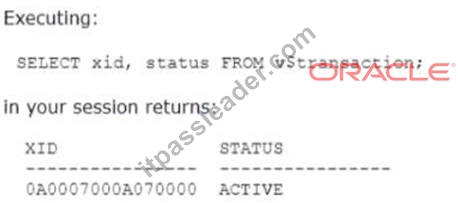
In which three situations will re-executing this query still return a row but with a different XID, indicating a new transaction has started?
- A. after successfully executing a commit or rollback followed by a select statement
- B. after successfully executing a create table statement followed by a create index statement
- C. after successfully executing a commit or rollback followed by a DML statement
- D. after successfully executing a DML statement following a failed DML statement
- E. after successfully executing a truncate statement followed by a DML statement
- F. after successfully executing a create table as select statement followed by a select for update statement
Answer: C,E,F
NEW QUESTION # 85
Examine this command: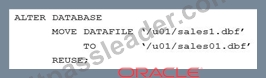
Which two statements are true? (Choose two.)
- A. The tablespace containing SALES1.DBF must be altered OFFLINE before executing the command.
- B. If Oracle Managed Files (OMF) is used, then the file is renamed but moved to DB_CREATE_FILE_DEST.
- C. DML may be performed on tables with one or more extents in this data file during the execution of this command.
- D. The tablespace containing SALES1.DBF must be altered READ ONLY before executing the command.
- E. The file is renamed and stored in the same location
Answer: C,D
NEW QUESTION # 86
Which two statements are true about the SET VERIFY ON command? (Choose two.)
- A. It displays values for variables created by the DEFINE command
- B. It displays values for variables prefixed with &&
- C. It displays values for variables used only in the WHERE clause of a query
- D. It can be used in SQL Developer and SQL*Plus
- E. It can be used only in SQL*Plus
Answer: B,D
NEW QUESTION # 87
Examine this command: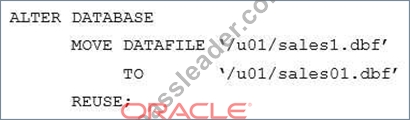
Which two statements are true? (Choose two.)
- A. The tablespace containing SALES1.DBF must be altered OFFLINE before executing the command.
- B. If Oracle Managed Files (OMF) is used, then the file is renamed but moved to DB_CREATE_FILE_DEST.
- C. DML may be performed on tables with one or more extents in this data file during the execution of this command.
- D. The tablespace containing SALES1.DBF must be altered READ ONLY before executing the command.
- E. The file is renamed and stored in the same location
Answer: C,D
NEW QUESTION # 88
Examine these commands: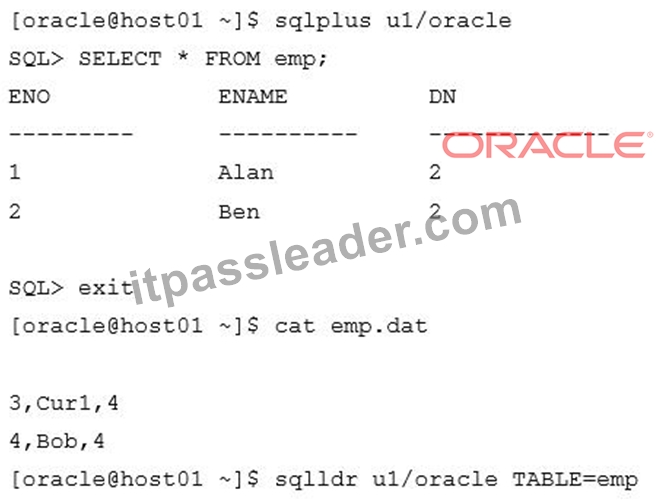
Which two statements are true about the sqlldr execution? (Choose two.)
- A. It overwrites data in EMP with data in EMP.DAT
- B. It generates a log that contains control file entries, which can be used with normal SQL*Loader operations
- C. It appends data from EMP.DAT to EMP
- D. It generates a sql script that it uses to load data from EMP.DAT to EMP
- E. It uses the database buffer cache to load data
Answer: B,C
NEW QUESTION # 89
Which two statements are true about trace files produced by the Oracle Database server? (Choose two.)
- A. All trace files contain error information that require contacting Oracle Support
- B. Trace files are written to the Fast Recovery Area (FRA)
- C. They can be written by background processes
- D. Trace file names are based on the database name concatenated with a sequential number
- E. They can be written by server processes
Answer: C,E
NEW QUESTION # 90
Examine this command:
Which two statements are true?
- A. It overwrites any existing file with the name SALES02.DBF.dbf in /u02 by default.
- B. Tables with one or more extents in this data file may be queried during the execution of this command.
- C. The "to" clause containing the new file name must be specified even if Oracle Managed Files (OMF) is used.
- D. Compressed objects in SALES01.DBF will be uncompressed In SALES02.DBF after the move.
- E. DML may be performed on tables with one or more extents in this data file during the execution of this command.
Answer: B,E
NEW QUESTION # 91
View the Exhibits and examine the structure of the COSTS and PROMOTIONS tables.
You want to display PROD_IDS whose promotion cost is less than the highest cost PROD_ID in a promotion time interval.
Examine this SQL statement: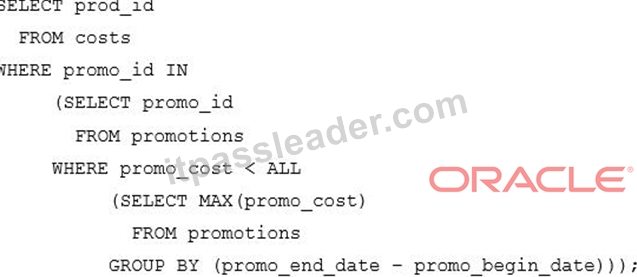
Exhibit 1.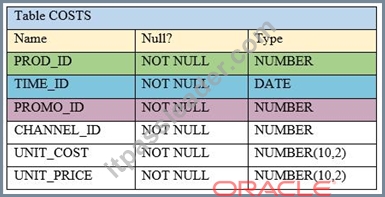
Exhibit 2.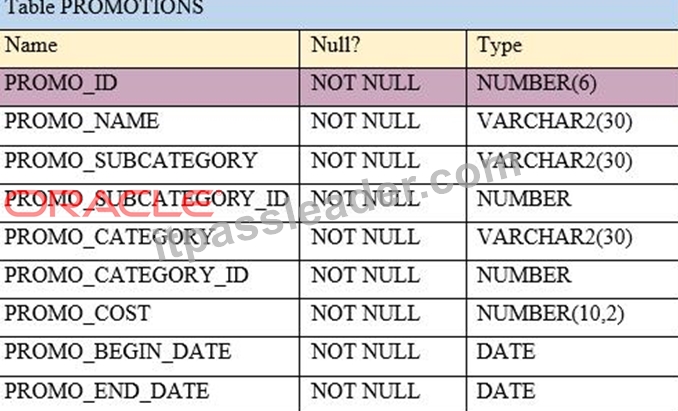
What will be the result?
- A. It gives an error because the ALL keyword is not valid
- B. It gives an error because the GROUP BY clause is not valid
- C. It executes successfully but does not give the required result
- D. It executes successfully and gives the required result
Answer: D
NEW QUESTION # 92
......
Free 1Z1-082 Test Questions Real Practice Test Questions: https://certlibrary.itpassleader.com/Oracle/1Z1-082-dumps-pass-exam.html