

2026 Easy Success Palo Alto Networks SD-WAN-Engineer Exam in First Try
Best SD-WAN-Engineer Exam Dumps for the Preparation of Latest Exam Questions
Palo Alto Networks SD-WAN-Engineer Exam Syllabus Topics:
| Topic | Details |
|---|---|
| Topic 1 |
|
| Topic 2 |
|
| Topic 3 |
|
| Topic 4 |
|
| Topic 5 |
|
NEW QUESTION # 35
An administrator has configured a Path Policy for "ERP_Traffic". The policy allows two public internet links,
"ISP-A" and "ISP-B", both marked as "Active". The Path Quality Profile (SLA) requires a latency of less than
150ms. Currently, both ISP-A and ISP-B have a latency of 40ms, well within the SLA.
How does the Prisma SD-WAN ION determine which link to use for a new flow of "ERP_Traffic" when both active paths meet the SLA requirements?
- A. It duplicates the packets across both paths (Packet Duplication) to ensure delivery.
- B. It selects the path that appears first in the interface configuration list.
- C. It selects the path with the highest available bandwidth capacity.
- D. It selects the path with the lowest numerical latency (e.g., if ISP-A drops to 39ms).
Answer: C
Explanation:
Comprehensive and Detailed Explanation
Prisma SD-WAN utilizes a sophisticated decision engine for Application-Based Path Selection that goes beyond simple failover. When configuring a Path Policy, the administrator defines "Active" paths and a "Path Quality Profile" (SLA).
* SLA Compliance (The Filter): First, the system filters the available paths based on the Path Quality Profile. In this scenario, both ISP-A and ISP-B have 40ms latency against a 150ms threshold. Both are
"green" or compliant paths.
* Selection Criteria (The Tie-Breaker): When multiple paths are configured as "Active" and all meet the performance SLA, the ION device aims to optimize the overall user experience and network utilization. The default behavior for load balancing across healthy, compliant active paths is to select the path with the highest available bandwidth capacity.
By steering new flows to the link with the most "headroom" (available Mbps), the system prevents the saturation of a smaller link (e.g., a 20Mbps DSL line) while a larger link (e.g., 1Gbps Fiber) sits underutilized.
This maximizes the aggregate throughput for the site. While latency is the qualifier, bandwidth availability is often the selector for compliant paths. Note that if the application was defined as "Real-Time" and configured for packet duplication, behavior would differ, but for standard traffic, capacity-based distribution is the standard active/active logic.
NEW QUESTION # 36
In the Prisma SD-WAN portal, the Application Health dashboard assigns a color-coded "Health Score" (Green, Yellow, Red) to applications.
Which three metrics are combined to calculate this composite AppX (Application Experience) score? (Choose three.)
- A. Transaction Failure Rate
- B. Jitter
- C. Network Transfer Time (NTT)
- D. Bandwidth Utilization
- E. Server Response Time (SRT)
Answer: A,C,E
Explanation:
Comprehensive and Detailed Explanation
The AppX (Application Experience) score is a proprietary metric used by Prisma SD-WAN to provide a holistic view of user experience, rather than just network statistics. It is calculated based on three key components:
* Transaction Failure Rate (A): The percentage of application transactions that failed (e.g., TCP resets, HTTP 500 errors). This indicates availability.
* Network Transfer Time (B): The time taken for packets to traverse the network (WAN/LAN latency).
This indicates network health.
* Server Response Time (C): The time taken by the application server to respond to a request. This indicates backend performance.
Why not D or E?
* Bandwidth Utilization (D) is a capacity metric, not a direct measure of quality. A link can be 90% full but still deliver packets quickly (good AppX), or 10% full but dropping packets (bad AppX).
* Jitter (E) is a network-layer metric primarily relevant for UDP Real-Time media. While important, the high-level "AppX" score for general TCP apps focuses on the "Time-to-Glass" metrics (NTT/SRT) and success rates.
NEW QUESTION # 37
A network engineer is troubleshooting a "Voice Quality" issue. They suspect that the DSCP markings are being stripped or altered by the ISP.
Which tool in the Prisma SD-WAN portal allows the engineer to capture live packets on the WAN interface and inspect the IP header ToS/DSCP field?
- A. Packet Capture (PCAP)
- B. Event Logs
- C. Path Quality Monitor
- D. Flow Browser
Answer: A
NEW QUESTION # 38
When troubleshooting an issue at a site that is running on two cellular links from two carriers, the operations team shared some evidence shown in the graph below:
(SNR Graph showing Carrier-1 in blue dropping to near 0 dB and Carrier-2 in green staying relatively stable between 4.5 dB and 6.5 dB)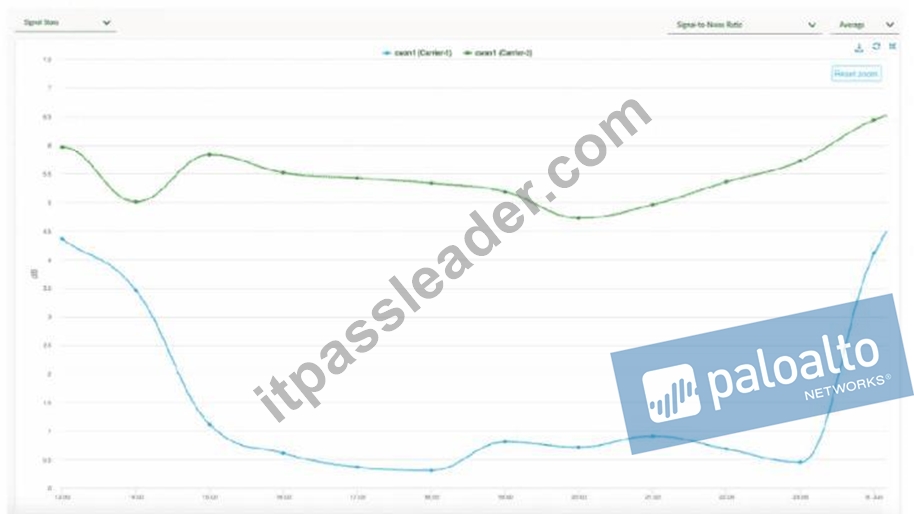
For the time duration shown in the graph, what are two inferences about the site's traffic that can be made?
(Choose two.)
- A. Using Carrier-2 as the WAN path may have switched over to Carrier-1.
- B. Using Carrier-2 as the WAN path may have experienced some performance degradation.
- C. Using Carrier-1 as the WAN path may have switched over to Carrier-2.
- D. Using Carrier-1 as the WAN path may have experienced some performance degradation.
Answer: C,D
Explanation:
In Prisma SD-WAN, the Signal-to-Noise Ratio (SNR) is a critical metric used to monitor the health and performance of cellular WAN interfaces. SNR measures the strength of the desired signal relative to the background noise level; higher values indicate a cleaner signal, while lower values suggest that noise is overwhelming the signal, typically leading to increased packet loss, high latency, and reduced throughput.
Analyzing the provided graph, Carrier-1 (blue line) shows a severe drop in SNR, plummeting from approximately 4.5 dB to nearly 0.3 dB between 15:00 and 23:00. An SNR value this low is indicative of a failing or highly unstable link that cannot reliably sustain data traffic, directly supporting Inference A-that Carrier-1 experienced significant performance degradation. In contrast, Carrier-2 (green line) maintains a much higher and more consistent SNR throughout the same period.
Prisma SD-WAN's AppFabric uses application-based path selection and SLA monitoring to ensure the best possible user experience. When the system detects that a primary path (like Carrier-1) has degraded below acceptable thresholds-often triggered by high loss or latency resulting from poor signal quality-it will dynamically steer application flows to an alternative healthy path. Therefore, Inference D is correct: because Carrier-1's quality became untenable while Carrier-2 remained stable, the ION device would have likely initiated a path switchover to move traffic from the degraded Carrier-1 to the healthier Carrier-2.
NEW QUESTION # 39
When identifying devices for IoT classification purposes, which two methods does Prisma SD-WAN use to discover devices that are not directly connected to the branch ION? (Choose two.)
- A. LLDP
- B. Syslog
- C. SNMP
- D. CDP
Answer: B,C
Explanation:
Comprehensive and Detailed Explanation
Prisma SD-WAN (formerly CloudGenix) integrates with Palo Alto Networks IoT Security to provide comprehensive visibility into all devices at a branch, including those that are not directly connected to the ION device. While the ION automatically detects and classifies devices connected directly to its interfaces via traffic inspection (DPI), DHCP, and ARP analysis, gaining visibility into off-branch devices (devices connected to downstream switches or access points) requires additional discovery mechanisms that can query the network infrastructure or ingest its logs.
1. SNMP (Simple Network Management Protocol): This is the primary active discovery method for off-branch devices. The Prisma SD-WAN ION device acts as a sensor that actively polls local network switches and wireless controllers using SNMP. By querying the ARP tables and MAC address tables (Bridge MIBs) of these intermediate network devices, the ION can identify endpoints that are connected to the switch ports, even if those endpoints are not currently sending traffic through the ION. This allows the system to map the topology and discover silent or lateral-traffic-only devices.
2. Syslog: In conjunction with SNMP, the IoT Security solution can utilize Syslog messages to discover and profile devices. Network infrastructure devices (like switches and WLAN controllers) can be configured to send Syslog messages to the collection point (which enables the IoT Security service) whenever a device connects or disconnects (e.g., port up/down events, DHCP snooping logs, or 802.1x authentication logs). These logs provide real-time data about device presence and identity (MAC/IP mappings) for devices that are not directly adjacent to the ION, ensuring 100% visibility across the branch network segments. LLDP (A) and CDP (B) are typically Link Layer discovery protocols used for discovering directly connected neighbors and do not propagate beyond the immediate link, making them unsuitable for discovering devices multiple hops away or behind a switch.
NEW QUESTION # 40
Based on the HA topology image below, which two statements describe the end-state when power is removed from the ION 1200-S labeled "Active", assuming that the ION labeled "Standby" becomes the active ION?
(Choose two.)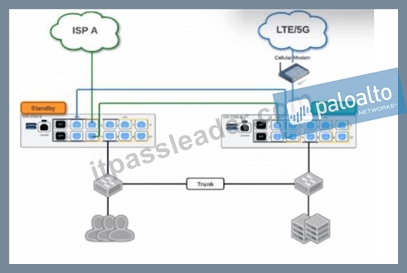
- A. The connection to ISP A will be usable, but the connection to LTE/5G will not.
- B. Both the connection to ISP A and the connection to LTE/5G will be usable.
- C. The newly active ION will send a gratuitous ARP to the LAN for the IP address of any SVIs.
- D. The VRRP Virtual IP address assigned to any SVIs will be moved to the newly active ION.
Answer: B,C
Explanation:
Comprehensive and Detailed Explanation
This scenario depicts a High Availability (HA) topology utilizing the ION 1200-S model's Fail-to-Wire (bypass) capabilities to share WAN links between two devices without needing external switches for every WAN connection.
1. WAN Link Availability (Statement A):
The diagram illustrates a "daisy-chain" cabling method supported by the ION 1200-S bypass pairs.
* ISP A (Green): Connects directly to the "Standby" (Left) unit first. Since the Standby unit remains powered on, it maintains direct access to ISP A.
* LTE/5G (Blue): Connects to the "Active" (Right) unit first. The connection then loops through a bypass pair on the Active unit to the Standby unit. When power is removed from the "Active" unit, the fail-to-wire relays on its Ethernet ports close physically. This creates a passive electrical bridge that connects the LTE modem directly to the Standby unit. The Standby unit (now becoming Active) will detect the link state change and successfully utilize the LTE connection. Therefore, both WAN links remain usable.
2. LAN Failover Mechanism (Statement C):
Prisma SD-WAN ION devices typically use a VRRP-like mechanism for LAN redundancy.
* When the "Active" node fails (loses power), the "Standby" node stops receiving keepalives and promotes itself to the Active state.
* To ensure downstream switches and clients immediately send traffic to the new Active unit, it must update their ARP tables. It does this by broadcasting a Gratuitous ARP (GARP) packet for the Virtual IP (VIP) address of the Switch Virtual Interfaces (SVIs). This action informs the network that the MAC address associated with the Gateway I1P is now reachable via the port connected to the new Active ION.234
NEW QUESTION # 41
A network design mandates segmentation at the routing level and traffic isolation across various services, such as teller cash registers, ATM traffic, guest Wi-Fi, and corporate applications. Which command can be used to validate and display the Virtual Routing and Forwarding (VRF) route leak rules?
- A. inspect flow_browser vrf all
- B. inspect vrf route_leak_rule all
- C. dump vrf route_leak_rule
- D. show interface vrf route_leak_rule all
Answer: B
Explanation:
In complex retail or banking environments, maintaining strict network segmentation is a regulatory and security requirement. Prisma SD-WAN utilizes Virtual Routing and Forwarding (VRF) to provide this isolation, ensuring that high-security traffic, such as ATM transactions or teller cash registers, remains logically separated from Guest Wi-Fi or general corporate applications. While isolation is the default state, route leaking is used to allow specific communication between these VRFs-for instance, allowing multiple isolated segments to reach a common shared service like a DNS server or a centralized security gateway.
To verify that these configurations have been correctly pushed from the Controller to the local ION device, administrators utilize the ION CLI (Command Line Interface) for deep-dive diagnostics. The command inspect vrf route_leak_rule all is the definitive tool for this purpose. Unlike "show" commands which typically provide interface status, "inspect" commands in the Prisma SD-WAN ecosystem are designed to pull real-time operational state data from the control plane's internal databases.
When executed, this command displays the specific prefix-level rules that allow routes to "leak" from one VRF table into another. It provides visibility into the source VRF, the destination VRF, and the exact network prefixes or default routes being shared. This is critical for troubleshooting "Day 2" operations; if a teller register cannot reach a shared database, the administrator can use this command to confirm if the necessary route leak rule is active and accurately reflecting the intent of the VRF Profile configured in the portal.
Without this command, verifying inter-VRF reachability would be limited to trial-and-error connectivity tests, making it an essential part of the Prisma SD-WAN engineer's toolkit.
NEW QUESTION # 42
Full discovery and classification of IoT devices by the IoT Security service is failing. Which Prisma SD- WAN ION device configuration will cause this behavior?
- A. The ION devices are missing DHCP Configuration. If ION devices are not explicitly configured as either a DHCP relay agent or a DHCP server, DHCP traffic logs will not be sent to the Strata Logging Service, resulting in incomplete device profiles for IoT Security.
- B. The Syslog export configuration on the ION devices to the Strata Logging Service has filters that are too restrictive, potentially excluding logs vital for IoT Security's device identification and classification engine. This prevents comprehensive event data, including device discovery messages, from reaching the portal.
- C. The ION devices are not configured to explicitly enable and export IPFIX flow records, especially those containing Layer 2 and Layer 7 context, to the Strata Logging Service for IoT Security. While ARP data is sent by default, comprehensive device classification relies on these detailed flow records, which are not being captured.
- D. The Prisma SD-WAN ION devices lack properly configured or enabled Service Health Probes specifically targeting the IoT device subnets. Without these active probes, the system cannot gather critical real-time reachability and performance metrics essential for dynamic device profiling and classification.
Answer: A
Explanation:
Palo Alto Networks IoT Security relies on rich metadata and traffic logs to identify, classify, and secure devices across the network. A critical component of this discovery process is the ingestion of DHCP (Dynamic Host Configuration Protocol) traffic. DHCP packets contain vital information about a device, such as the MAC address, vendor-specific identifiers (Option 60), and hostnames, which are used by the machine learning engine to create a precise device profile.
In a Prisma SD-WAN environment, if the ION devices are not involved in the DHCP process, the necessary logs cannot be forwarded to the Strata Logging Service (SLS) for analysis by the IoT Security cloud. To ensure successful discovery, the ION device at the branch must be explicitly configured as either the DHCP Server for the local segment or as a DHCP Relay Agent. When the ION handles DHCP traffic, it automatically extracts and sends the relevant metadata to the cloud.
If the ION is bypassed-for example, if a local Layer 3 switch is handling DHCP internally without relaying it to the ION-the IoT Security service will lack the context needed to move beyond basic IP-level visibility.
Without these DHCP-derived "fingerprints," the system cannot perform the full classification required to apply granular security policies or identify potential vulnerabilities. Therefore, verifying that the ION device is correctly integrated into the DHCP lifecycle is the primary troubleshooting step for incomplete IoT device discovery in the Prisma SD-WAN portal.
NEW QUESTION # 43
Which statement is valid when integrating Prisma SD-WAN with Prisma Access remote networks?
- A. Easy onboarding automatically recommends the closest preconfigured remote network security processing nodes and can be overridden manually.
- B. A branch with multiple internet circuits will automatically connect to Prisma Access on each circuit and will be used in an active/standby manner for internet-bound traffic.
- C. Bandwidth must be allocated to each Prisma Access remote network compute location, and this bandwidth is shared between all branches that terminate on this remote network node.
- D. Security policies for remote networks are configured in Prisma Access and pushed to Prisma SD-WAN for enforcement on the branch ION devices.
Answer: C
Explanation:
Comprehensive and Detailed Explanation
When deploying Prisma Access for Remote Networks (connecting branch offices), the licensing and throughput model is based on aggregate bandwidth allocated to specific compute locations (regions).
Bandwidth Allocation (Option D): Administrators must purchase and allocate a specific amount of bandwidth (e.g., 500 Mbps, 1 Gbps) to a Prisma Access "Compute Location" (e.g., US West, Europe Central). This allocated bandwidth is then shared as a pool among all the branch sites (Remote Networks) that onboard and terminate their IPSec tunnels at that specific location. The system does not allocate bandwidth on a strict per-site basis but rather enforces the limit on the aggregate throughput of the compute node itself.
Policy Enforcement (Option A): Security policies for Prisma Access are enforced in the cloud (at the Prisma Access Service Processing Node), not pushed down to the branch ION devices for local enforcement. The ION device handles local segmentation (ZBFW) and traffic steering, but the "Remote Network" security stack resides in the cloud.
Path Usage (Option C): Prisma SD-WAN is designed to utilize Active/Active paths. When a branch has multiple internet circuits connected to Prisma Access, the CloudBlade and ION automatically build tunnels on all compatible paths and can load-balance traffic across them based on application performance (SLA), rather than defaulting to a strict Active/Standby model for internet traffic.
NEW QUESTION # 44
A multinational company is deploying Prisma SD-WAN across North America, Europe, and Asia. The data centers in the North America region have served all regions, but regional policies are now being enforced that mandate each of the regions to build their own data centers and branch sites to only connect to their respective regional data centers.
How can this regionalization be achieved so that new or existing branch sites only build tunnels to the regional DC IONs?
- A. Remove the circuit labels and apply new circuit labels for in-region circuits only.
- B. Disable the auto-tunnel feature globally on the Prisma SD-WAN portal and manually create all necessary tunnels exclusively between IONs within their designated regions.
- C. Assign WAN interfaces to distinct Virtual Routing and Forwarding (VRF) instances for each region on the DC IONs, ensuring that branches only connect to the WAN interfaces/VRFs designated for their region.
- D. Create a new cluster for each regional DC ION and move the sites from the existing cluster to the new cluster.
Answer: D
Explanation:
Comprehensive and Detailed Explanation
To achieve strict regional isolation where branch sites only form VPN tunnels with Data Centers in their specific region (e.g., EU branches to EU DCs only), the correct architectural feature to utilize is VPN Clusters
.
In Prisma SD-WAN (CloudGenix), a Cluster defines a logical security and topology boundary for the overlay network. By default, devices may be placed in a "Default" cluster where they attempt to form a mesh or hub- and-spoke topology with all other reachable devices in that context.
To enforce the new policy:
* Logical Partitioning: The administrator should create separate VPN Clusters for each region (e.g.,
"Cluster-NA", "Cluster-EU", "Cluster-Asia").
* Assignment: The Regional Data Center IONs and their corresponding Branch IONs must be moved into their respective clusters.
* Result: The Prisma SD-WAN controller dictates that devices can only establish Secure Fabric (VPN) tunnels with other devices within the same cluster. This effectively segments the global network, ensuring that an Asian branch never attempts to build a tunnel to a North American DC, satisfying the compliance requirement without complex access lists or manual tunnel configuration.
* Option B (Manual Tunnels) is administratively unscalable and negates the benefits of SD-WAN automation.
* Option C (Circuit Labels) is primarily for path selection and traffic steering, not for hard topology segmentation.
* Option D (VRFs) is used for local Layer 3 segmentation (routing isolation) within a device, not for controlling WAN overlay tunnel formation scope.
NEW QUESTION # 45
When configuring a Path Policy rule for a "Real-Time Video" application, the administrator wants to ensure the traffic uses the path with the lowest packet loss.
How does the Prisma SD-WAN ION determine the "Packet Loss" metric for a given path when there is no active user traffic flowing on that link?
- A. It relies solely on Passive Monitoring of TCP retransmissions from other user traffic on that link.
- B. It defaults to a static value of 0% loss until user traffic begins.
- C. It sends Active Probes (synthetic UDP packets) across the Secure Fabric to measure path quality continuously.
- D. It queries the ISP's router via SNMP to retrieve interface error counters.
Answer: C
Explanation:
Comprehensive and Detailed Explanation
Prisma SD-WAN utilizes Link Quality Monitoring (LQM) to maintain a real-time health score for every WAN path.
To ensure the system knows the quality of a path before sending critical user traffic onto it, the ION device uses Active Probing.
Mechanism: The ION sends synthetic probe packets (typically UDP) across the Secure Fabric (VPN tunnels) and Direct Internet paths to its peers. These probes measure Latency, Jitter, and Packet Loss.
Active vs. Passive: While the system does use Passive Monitoring (observing actual user flows) when traffic is present to reduce overhead, Active Probes are essential for idle links or backup paths. Without active probing, the ION would have no data to make an intelligent steering decision for the first packet of a new video call. This ensures that "Real-Time" policies always have up-to-date metrics to select the best path immediately.
NEW QUESTION # 46
An administrator needs to ensure that critical VoIP traffic is not dropped even when the branch's primary internet link is fully saturated with bulk file transfers.
Which QoS mechanism does Prisma SD-WAN automatically apply to the "Platinum" priority class to prevent starvation by lower-priority classes?
- A. First-In, First-Out (FIFO)
- B. Strict Priority Queuing (SPQ)
- C. Hierarchical Token Bucket (HTB) with guaranteed bandwidth
- D. Weighted Round Robin (WRR)
Answer: C
Explanation:
Comprehensive and Detailed Explanation
Prisma SD-WAN utilizes a hierarchical QoS model (typically based on Hierarchical Token Bucket or similar shaping algorithms) to manage bandwidth contention.
Guaranteed Bandwidth: The "Platinum" class (used for Real-Time voice/video) is assigned a guaranteed bandwidth percentage (floor) in the QoS profile. This ensures that even if "Gold" (Transactional) or "Silver" (Bulk) traffic is trying to consume 100% of the link, the scheduler reserves the specific portion (e.g., 30%) for Platinum traffic, preventing starvation.
Shaping, not Policing: Unlike simple policing which drops excess traffic hard, the ION device shapes the egress traffic. If the link is congested, the scheduler delays the lower-priority packets (buffering) to allow the high-priority Platinum packets to exit immediately.
Why not Strict Priority (A)? While Platinum behaves like a priority queue, pure Strict Priority can completely starve lower queues if the high-priority traffic is misbehaving or voluminous. Prisma SD-WAN typically uses bandwidth guarantees (floors) and limits (ceilings) to ensure fair sharing while protecting critical apps.
NEW QUESTION # 47
A branch manager reports slow network performance, and the network administrator wants to use Prisma SD- WAN Copilot to quickly identify if a specific user, by source IP address, is consuming excessive bandwidth as well as which applications are contributing to this consumption. How can Copilot assist in this investigation?
- A. It will redirect the administrator to the WAN Clarity "Top N: Source IPs" report and the "Flow Browser" utility, suggesting correlation between these tools to determine a user's specific application usage.
- B. It can identify the top applications being used across the entire branch and can be correlated with Flow Browser to attribute specific application usage or total bandwidth consumption to individual source IPs.
- C. It can directly process a natural language query such as "Show top bandwidth source IPs at SD-WAN Branch X over last 3 hours," provide summarized views of the top-consuming source IPs, and view the primary applications they are using.
- D. It will automatically generate and email a "User Bandwidth Consumption" report for the specified branch, which the administrator can use to find the top user and the application details.
Answer: C
Explanation:
Prisma SD-WAN Copilot is an AI-powered operational tool designed to simplify network management through Natural Language Processing (NLP). Traditionally, identifying a bandwidth "hog" required manual navigation through multiple dashboards, such as WAN Clarity and the Flow Browser, to correlate source IP addresses with specific application flows and timestamps. Copilot transforms this workflow by allowing administrators to interact with the system using conversational queries.
When an administrator inputs a query like "Show top bandwidth source IPs at SD-WAN Branch X over last 3 hours," Copilot leverages its underlying machine learning models and integrated data lake to aggregate telemetry across the entire fabric. It instantly identifies the specific source IPs responsible for the highest throughput and correlates that data with application visibility. Instead of providing a static report or redirecting the user to other tools, Copilot presents an interactive, summarized view directly within the interface. This view highlights the top-consuming users and breaks down their consumption by application, such as YouTube, Netflix, or business-critical SaaS tools.
This capability significantly reduces the Mean Time to Resolution (MTTR) for performance issues. By bypassing the need for manual data correlation, Copilot provides immediate "Day 2" operational insights. It effectively acts as a virtual assistant that understands the context of the network topology, site names, and time ranges, allowing the administrator to quickly determine if a branch's slow performance is due to an individual user's behavior or a broader infrastructure issue.
NEW QUESTION # 48
A network administrator notices that a branch ION device is experiencing high CPU utilization due to a suspected TCP SYN Flood attack originating from a compromised host on the local LAN.
Which specific security feature should be configured and applied to the "LAN" zone to mitigate this Denial of Service (DoS) attack?
- A. Zone Protection Profile
- B. Access Control List (ACL) on the WAN interface
- C. Zone-Based Firewall (ZBFW) Rule with a "Deny" action
- D. Application Quality Profile (AQP)
Answer: A
Explanation:
Comprehensive and Detailed Explanation
To defend against volumetric attacks such as TCP SYN Floods, UDP Floods, or ICMP Floods, Prisma SD-WAN (like PAN-OS) utilizes Zone Protection Profiles.
Function: A Zone Protection Profile is a specific security object designed to screen traffic for protocol anomalies and flood behaviors before it is processed by the complex firewall policy engine. It sets thresholds (e.g., "Max 1000 SYNs/sec"). If the traffic rate exceeds this threshold, the system triggers an action (Alarm, Drop, or SYN Cookies) to protect the device's resources.
Application: Unlike a standard ZBFW Rule (A) which filters based on Source/Destination/App-ID (which might still allow the initial handshake packets that cause the flood), a Zone Protection Profile is applied to the Zone object itself (in this case, the LAN Zone). This ensures that the flood is mitigated at the ingress stage, preventing the ION's session table and CPU from being exhausted by the attack.
NEW QUESTION # 49
An ION 3000 device at a remote branch has suffered a critical hardware failure and must be replaced via the RMA process. The administrator has received the replacement unit.
What is the correct procedure to transfer the configuration and license from the defective unit to the replacement unit to ensure minimal downtime and retention of historical data?
- A. Backup the configuration of the old device to a USB drive and restore it to the new device using the local console.
- B. Manually configure the new device from scratch, then open a support ticket to transfer the license.
- C. Use the "Replace Device" workflow in the Prisma SD-WAN portal, which automatically transfers the configuration (Device Shell) and re-associates the site to the new serial number.
- D. Delete the old device from the portal, create a new site for the replacement device, and rebuild the policies manually.
Answer: C
Explanation:
Comprehensive and Detailed Explanation
The RMA replacement process in Prisma SD-WAN is designed to be seamless, leveraging the decoupling of logical configuration from physical hardware.
Replace Device Workflow: The administrator should use the "Replace Device" (or RMA) function within the portal. This workflow allows you to select the "Defective" device (old serial) and the "Replacement" device (new serial).
Configuration Transfer: Once executed, the system automatically binds the existing Device Shell (which contains all interface configs, routing policies, and site associations) to the new hardware's serial number. The new device, once connected to the internet, will "call home," identify itself, and download the exact configuration of the previous unit.
License Transfer: While the configuration moves automatically, the Support License transfer typically requires a specific step in the Customer Support Portal (CSP) or happens automatically if processed as a formal RMA order. Options A and D are incorrect because they involve manual reconfiguration, which is unnecessary and error-prone. Option C is incorrect as the ION platform relies on cloud-based config management, not local USB backups for hardware swaps.
NEW QUESTION # 50
An organization has provided the following technical requirements and details:
* High availability (HA) at all data center and branch locations
* Two geographically separate main data center locations
* One small data center location that contains local users and applications requiring policies
* 50 branch locations
* ISP capacities for all branch locations but no accurate measurement of the actual bandwidth consumption Based on Palo Alto Networks best practices and recommendations, which two licensing options will meet the customer objectives? (Choose two.)
- A. Branch subscription per site
- B. Aggregate bandwidth subscription
- C. Four data center subscriptions
- D. Six data center subscriptions
Answer: B,D
Explanation:
Prisma SD-WAN licensing is structured to provide flexibility while ensuring that all components of the secure fabric are correctly accounted for. To meet the requirements of this organization, we must calculate the necessary subscriptions for both the data center hubs and the distributed branch network.
First, we address the Data Center Subscriptions. The organization has two main geographically separate data centers and one small data center, all of which require High Availability (HA). In a Prisma SD-WAN deployment, HA at a site is achieved by deploying two ION devices in a cluster. Palo Alto Networks licensing requires a separate Data Center subscription for each ION device acting as a hub. Therefore, with three data center locations (2 main + 1 small) each requiring an HA pair (2 devices per site), a total of six data center subscriptions (Option A) are required to license all six hub appliances.
Second, we address the Branch Subscriptions. The organization has 50 branches but lacks accurate measurements of actual bandwidth consumption. Palo Alto Networks' best practice for such scenarios is the Aggregate Bandwidth Subscription model (Option B). Instead of purchasing a fixed "Branch subscription per site" (Option D)-which requires knowing the exact throughput needs for every individual location-the aggregate model allows the customer to purchase a total pool of bandwidth (e.g., 5 Gbps) that is shared across all 50 branch sites.
This "pay-as-you-grow" approach is ideal when consumption patterns are unknown or inconsistent. As branches utilize the bandwidth, it is deducted from the central pool. This avoids the risk of over-provisioning licenses at low-usage sites or under-provisioning at high-usage sites. Together, the six DC subscriptions and the aggregate bandwidth pool provide a fully licensed, HA-capable SD-WAN environment that aligns with Palo Alto Networks' scaling recommendations.
NEW QUESTION # 51
In a Prisma SD-WAN deployment, what is the defining characteristic of a "Standard VPN" compared to a "Secure Fabric Link"?
- A. Standard VPNs support BGP, whereas Secure Fabric Links only support static routing.
- B. Standard VPNs are automatically built between ION devices, while Secure Fabric Links require manual configuration.
- C. Standard VPNs use GRE encapsulation, while Secure Fabric Links use VXLAN.
- D. Standard VPNs are manually configured IPSec tunnels to non-ION endpoints, while Secure Fabric Links are automated tunnels between ION devices.
Answer: D
Explanation:
Comprehensive and Detailed Explanation
In the Prisma SD-WAN architecture, the terminology distinguishes between "Native" automation and "Legacy" interoperability.
Secure Fabric Links: These are the proprietary, automated overlay tunnels created between two Prisma SD-WAN ION devices (e.g., Branch ION to Data Center ION). The controller automatically manages the IP addressing, key rotation, and routing for these links. You do not manually configure "Phase 1" or "Phase 2" parameters for Secure Fabric links.
Standard VPNs: These are traditional, standards-based IPSec tunnels configured to connect an ION device to a Non-ION endpoint (Third-Party Peer). This is used for "Data Center to Data Center" connections where one side is a legacy firewall (e.g., Cisco ASA, Palo Alto Networks NGFW) or for connecting to cloud security services (SSE) that do not have a specific CloudBlade integration. For a Standard VPN, the administrator must manually define the IKE/IPSec profiles, pre-shared keys, and peer IP addresses to match the third-party device's configuration.
NEW QUESTION # 52
By default, how many days will Prisma SD-WAN VPNs stay operational before the keys expire when an ION device loses connection with the controller?
- A. 0
- B. 1
- C. 2
- D. 3
Answer: C
Explanation:
Comprehensive and Detailed Explanation
The Prisma SD-WAN (CloudGenix) solution is designed with a separation of the control plane (Controller) and the data plane (ION devices).1 In the event that an ION device loses connectivity to the Cloud Controller (often referred to as running in "headless mode"), the device continues to forward traffic and maintain existing VPN tunnels using the keys it currently holds.2 However, for security purposes, the VPN session keys (shared secrets) used for the Secure Fabric have a finite validity period. The system is designed such that these keys are rotated regularly.3 If the controller is unreachable, the ION device can continue to rotate keys locally and maintain the VPNs for a maximum default period of 72 hours (exactly 3 days).4 If the connection to the controller is not restored within this 72-hour window, the keys will eventually expire, and the ION will be unable to retrieve new authorized key material from the controller.5 Consequently, the VPN tunnels will go down, and the "out of shared secret key" error will be observed in the VPN status logs.
This mechanism ensures that a permanently compromised or stolen device cannot maintain network access indefinitely without central authorization.
NEW QUESTION # 53
In a data center (DC) with two ION devices, all of the remote branch Prisma SD-WAN VPNs are active only on DC ION-1.
Why are no VPNs active on DC ION-2?
- A. The ION device is behind a NAT.
- B. The BGP core peer is down.
- C. The static route to core as a next hop is missing.
- D. The DC and branches are in a different domain.
Answer: B
Explanation:
Comprehensive and Detailed Explanation
In a Prisma SD-WAN Data Center deployment, the operational state of the Secure Fabric VPNs (overlay tunnels) is directly tied to the health of the BGP Core Peer configuration.4 Core Peer Dependency: DC ION devices typically peer with the data center core switch (Core Router) via BGP to learn the subnets (prefixes) for the applications hosted in the DC. The Prisma SD-WAN controller monitors this BGP peering status.5 Controller Logic: If the BGP Core Peer on a DC ION goes down (or is not established), the controller automatically marks the VPN tunnels terminating at that specific ION as "Inactive".6 This is a fail-safe mechanism designed to prevent remote branches from sending traffic to a DC ION that has lost conne7ctivity to the internal data center network (and thus the applications).
Scenario Analysis: In this scenario, DC ION-1 has active VPNs, meaning its BGP Core Peer is UP and it is successfully advertising reachability. DC ION-2 has no active VPNs, which strongly indicates that its BGP Core Peer is down.8 Because the controller sees the peer is down, it suppresses the tunnel establishment or marks existing tunnels as inactive to ensure traffic is only directed to the healthy node (ION-1).
NEW QUESTION # 54
......
SD-WAN-Engineer Study Material, Preparation Guide and PDF Download: https://certlibrary.itpassleader.com/Palo-Alto-Networks/SD-WAN-Engineer-dumps-pass-exam.html