

[2025] Pass Oracle 1z0-809 Test Practice Test Questions Exam Dumps
Verified 1z0-809 dumps Q&As - 1z0-809 dumps with Correct Answers
Oracle 1z1-809 is a professional certification exam designed for Java SE 8 programmers who want to advance their career in the field of software development. Java SE 8 Programmer II certification exam is considered to be one of the most sought-after exams in the Java development community. 1z0-809 exam measures the candidate's knowledge, skills, and abilities to work with Java SE 8 programming language.
NEW QUESTION # 77
Given:
public class Test<T> {
private T t;
public T get () {
return t;
}
public void set (T t) {
this.t = t;
}
public static void main (String args [ ] ) {
Test<String> type = new Test<>();
Test type 1 = new Test (); //line n1
type.set("Java");
type1.set(100); //line n2
System.out.print(type.get() + " " + type1.get());
}
}
What is the result?
- A. java.lang.string@<hashcode>java.lang.Integer@<hashcode>
- B. Java 100
- C. A compilation error occurs. To rectify it, replace line n2with:
type1.set (Integer(100)); - D. A compilation error occurs. To rectify it, replace line n1with:
Test<Integer> type1 = new Test<>();
Answer: D
NEW QUESTION # 78
For which three objects must a vendor provide implementations in its JDBC driver?
- A. DriverManager
- B. Time
- C. SQLException
- D. ResultSet
- E. Date
- F. Statement
- G. Connection
Answer: D,F,G
Explanation:
Database vendors support JDBC through the JDBC driver interface or through the ODBC connection. Each driver must provide implementations of java.sql.Connection, java.sql.Statement, java.sql.PreparedStatement, java.sql.CallableStatement, and java.sql.Re sultSet. They must also implement the java.sql.Driver interface for use by the generic java.sql.DriverManager interface.
NEW QUESTION # 79
Given the for loop construct:
for ( expr1 ; expr2 ; expr3 ) {
statement;
}
Which two statements are true?
- A. The expression expr3 must be present. It is evaluated after each iteration through the loop.
- B. When expr2 evaluates to false, the loop terminates. It is evaluated only after each iteration through the loop.
- C. The expression expr1 is optional. it initializes the loop and is evaluated once, as the loop begin.
- D. This is not the only valid for loop construct; there exits another form of for loop constructor.
Answer: B,C
Explanation:
The for statement have this forms:
for (init-stmt; condition; next-stmt) {
body
}
There are three clauses in the for statement.
The init-stmt statement is done before the loop is started, usually to initialize an iteration variable.
The condition expression is tested before each time the loop is done. The loop isn't executed if the boolean expression is false (the same as the while loop). The next-stmt statement is done after the body is executed. It typically increments an iteration variable.
NEW QUESTION # 80
Which two methods from the java.util.stream.Stream interface perform a reduction operation?
(Choose two.)
- A. filter ()
- B. peek ()
- C. distinct ()
- D. count ()
- E. collect ()
Answer: D,E
NEW QUESTION # 81
Given the code fragments:
class Employee {
Optional<Address> address;
Employee (Optional<Address> address) {
this.address = address;
}
public Optional<Address> getAddress() { return address; }
}
class Address {
String city = "New York";
public String getCity { return city: }
public String toString() {
return city;
}
}
and
Address address = null;
Optional<Address> addrs1 = Optional.ofNullable (address);
Employee e1 = new Employee (addrs1);
String eAddress = (addrs1.isPresent()) ? addrs1.get().getCity() : "City Not
available";
What is the result?
- A. A NoSuchElementException is thrown at run time.
- B. null
- C. City Not available
- D. New York
Answer: B
NEW QUESTION # 82
Which statement is true about the switch statement?
- A. It must contain the default section.
- B. Its case label literals can be changed at runtime.
- C. The break statement, at the end of each case block, is mandatory.
- D. Its expression must evaluate to a single value.
Answer: D
NEW QUESTION # 83
Given:
interface Rideable {Car getCar (String name); }
class Car {
private String name;
public Car (String name) {
this.name = name;
}
}
Which code fragment creates an instance of Car?
- A. Rideable rider = Car : : new;
Car vehicle = rider.getCar("MyCar"); - B. Car auto = Car ("MyCar"): : new;
- C. Car vehicle = Rideable : : new : : getCar("MyCar");
- D. Car auto = Car : : new;
Car vehicle = auto : : getCar("MyCar");
Answer: A
NEW QUESTION # 84
Given:
public class Emp {
String fName;
String lName;
public Emp (String fn, String ln) {
fName = fn;
lName = ln;
}
public String getfName() { return fName; }
public String getlName() { return lName; }
}
and the code fragment:
List<Emp> emp = Arrays.asList (
new Emp ("John", "Smith"),
new Emp ("Peter", "Sam"),
new Emp ("Thomas", "Wale"));
emp.stream()
//line n1
.collect(Collectors.toList());
Which code fragment, when inserted at line n1, sorts the employees list in descending order of fName and then ascending order of lName?
- A. .sorted
(Comparator.comparing(Emp::getfName).reserved().thenComparing(Emp::getlName)) - B. .map(Emp::getfName).sorted(Comparator.reserveOrder().map(Emp::getlName).reserved
- C. .sorted (Comparator.comparing(Emp::getfName).thenComparing(Emp::getlName))
- D. .map(Emp::getfName).sorted(Comparator.reserveOrder())
Answer: A
NEW QUESTION # 85
Given:
What is the result?
- A. Hi MyClass
- B. Hi Interface-1
- C. A compilation error occurs.
- D. Hi Interface-2
Answer: A
NEW QUESTION # 86
Given:
Which two classes use the shape class correctly?
- A. Option C
- B. Option D
- C. Option F
- D. Option B
- E. Option A
- F. Option E
Answer: D,F
Explanation:
When an abstract class is subclassed, the subclass usually provides implementations for all of the abstract methods in its parent class (E). However, if it does not, then the subclass must also be declared abstract (B). Note: An abstract class is a class that is declared abstract-it may or may not include abstract methods. Abstract classes cannot be instantiated, but they can be subclassed.
NEW QUESTION # 87
Given:
class CheckClass {
public static int checkValue (String s1, String s2) {
return s1 length() - s2.length();
}
}
and the code fragment:
String[] strArray = new String [] {"Tiger", "Rat", "Cat", "Lion"}
//line n1
for (String s : strArray) {
System.out.print (s + " ");
}
Which code fragment should be inserted at line n1 to enable the code to print Rat Cat Lion Tiger?
- A. Arrays.sort(strArray, CheckClass : : checkValue);
- B. Arrays.sort(strArray, (CheckClass : : new).checkValue);
- C. Arrays.sort(strArray, CheckClass : : new : : checkValue);
- D. Arrays.sort(strArray, (CheckClass : : new) : : checkValue);
Answer: C
NEW QUESTION # 88
Given the code fragment:
What is the result?
- A. Java EESE
- B. Java EEJava EESE
- C. Java EEJava SE
- D. The program prints either:Java EEJava SEorJava SEJava EE
Answer: D
NEW QUESTION # 89
Given:
and the code fragment:
What is the result?
- A. An exception is thrown at line n2.
- B. A compilation error occurs because the try block is declared without a catch or finally block.
- C. A compilation error occurs at line n1.
- D. 0
Answer: D
NEW QUESTION # 90
In 2015, daylight saving time in New York, USA, begins on March 8th at 2:00 AM. As a result, 2:00 AM becomes 3:00 AM.
Given the code fragment:
Which is the result?
- A. 4:00 - difference: 2
- B. 2:00 - difference: 1
- C. 4:00 - difference: 3
- D. 3:00 - difference: 2
Answer: A
NEW QUESTION # 91
Given: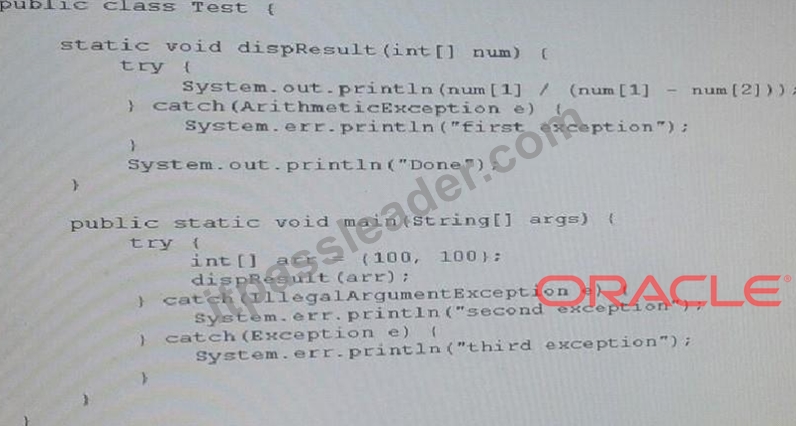
What is the result?
- A. First Exception
Done - B. Second Exception
- C. 0
Done - D. Third Exception
- E. Done
Third Exception
Answer: D
NEW QUESTION # 92
Given:
What is the result?
Bar Hello
- A. A compilation error occurs in the Dazeclass.
- B. Foo Hello
Bar Hello - C. Baz Hello
Baz Hello - D.
Answer: C
NEW QUESTION # 93
Given the code fragment:
Which three code fragments can be independently inserted at line n1 to enable the code to print one?
- A. short x = 1;
- B. double x = 1;
- C. string x = "1";
- D. Integer x = new Integer ("1") ;
- E. long x = 1;
- F. byte x = 1;
Answer: A,D,F
NEW QUESTION # 94
Given:
Your design requires that:
* fuelLevel of Engine must be greater than zero when the start() method is invoked.
* The code must terminate if fuelLevel of Engine is less than or equal to zero.
Which code fragment should be added at line n1 to express this invariant condition?
- A. assert fuelLevel < 0: System.exit(0);
- B. assert fuelLevel > 0: "Impossible fuel" ;
- C. assert (fuelLevel > 0) : System.out.println ("Impossible fuel");
- D. assert (fuelLevel) : "Terminating...";
Answer: A
NEW QUESTION # 95
......
1z0-809 certification guide Q&A from Training Expert ITPassLeader: https://certlibrary.itpassleader.com/Oracle/1z0-809-dumps-pass-exam.html